eDiscoveryDaily

Judge Recommends Jury Decision on Impact of Spoliation of Emails: eDiscovery Case Law

In BankDirect Capital Fin., LLC v. Capital Premium Fin., Inc., No. 15 C 10340 (N.D. Ill. April 4, 2018), Illinois Magistrate Judge Jeffrey Cole recommended that the court follow the decision in Cahill v. Dart and “allow the appropriate evidence to be presented to the jury” to enable it to determine the “impact, if any, the non-production of the challenged emails has on the merits of the parties’ claims”.  If the court was not inclined to let the matter go to the jury, Judge Cole recommended that the court give a permissive spoliation instruction to the jury informing them of the destruction of the requested emails and that they could consider the deletion of the emails to be evidence in considering claims and counter-claims of the parties.

Case Background

In this case regarding breach of a marketing collaboration agreement between the parties and a counter-claim against the owner of the plaintiff, alleging the marketing agreement was negotiated in bad faith, the defendant raised concerns that the plaintiff had produced no emails from Fall 2010 through November 2011 (the period in which the parties were negotiating their Agreement).  The plaintiff indicated that it changed servers in November 2011 and no longer had possession of any emails prior to then.  In response to the suggestion that the loss of the pre-November 2011 emails might have been deliberate, the plaintiff claimed that the server change was “years before any party could have foreseen litigation”.  Though the parties agreed to a declaration by an employee of the plaintiff regarding this, the plaintiff never provided one.

In May 2017, the defendant served a notice for the deposition of a corporate representative of the plaintiff to cover a number of topics related to the missing emails, but the parties continued to dispute the production of a plaintiff witness before finally agreeing to depose an employee of the bank owner company of the plaintiff.  He testified that the new email archive system was not fully installed at the plaintiff’s organization until July 2012, that five years of emails were kept at the time and that emails were kept until automatically deleted once they aged five years.  This meant that emails going back to November 2010 were in existence and obtainable as of November 2015 when the Complaint was filed, not purged when the plaintiff changed servers.

In addition, the President and CEO of the plaintiff admitted he maintained a separate electronic or computerized “folder” for emails regarding the agreement, this folder would have contained all the communications related to it as of July 2012 when the migration to the new archive was complete and he knew of no reason why he would have deleted them.  Acknowledging that he was “personally responsible for putting in place a litigation hold”, he also admitted that neither he nor anyone else at the plaintiff or its owner company ordered the suspension of the automatic deletion of archived emails until at least October of 2016, nearly a year after the defendant filed suit, noting that he didn’t think there were any bad emails, so their deletion wasn’t problematic.  The chain of events led to the defendant filing a Motion for Spoliation Sanctions seeking the entry of a default judgment or, alternatively, an adverse inference sanction against the plaintiff.

Judge’s Ruling

In providing his recommendation, Judge Cole stated that the plaintiff CEO testimony “is simply not credible”.  Continuing, he said, “No reasonable, successful businessman would be so naive as to think that prior, positive exchanges of emails with one’s present accuser had no capacity to help prove that Capital’s charges were baseless and pretextual.”

Summing up his observations, Judge Cole stated that “there can be no serious doubt that the now unavailable emails ought to have been preserved, and that BankDirect, despite its admitted knowledge that documents were not to be destroyed, intentionally chose not to take reasonable (and quite easy) steps to preserve them.”  As a result, Judge Cole offered the following recommendation:

“Accordingly, it is recommended that the court follow Cahill and, as a matter of its inherent discretion, allow the appropriate evidence to be presented to the jury, which, under proper instructions, will determine the reasons for the non-production and the impact, if any, the non-production of the challenged emails has on the merits of the parties’ claims. Alternatively, if the court is not inclined to let the matter go to the jury, it is recommended that the court give a permissive spoliation instruction to the jury informing them of the destruction of the requested emails and that they could consider the deletion “of the emails to be evidence (not conclusive of course)” in considering BankDirect’s claim and Capital’s counterclaim.”

So, what do you think?  Should the judge have recommended a default judgment sanction in this case?  Please share any comments you might have or if you’d like to know more about a particular topic.

Case opinion link courtesy of eDiscovery Assistant.

Sponsor: This blog is sponsored by CloudNine, which is a data and legal discovery technology company with proven expertise in simplifying and automating the discovery of data for audits, investigations, and litigation. Used by legal and business customers worldwide including more than 50 of the top 250 Am Law firms and many of the world’s leading corporations, CloudNine’s eDiscovery automation software and services help customers gain insight and intelligence on electronic data.

Disclaimer: The views represented herein are exclusively the views of the author, and do not necessarily represent the views held by CloudNine. eDiscovery Daily is made available by CloudNine solely for educational purposes to provide general information about general eDiscovery principles and not to provide specific legal advice applicable to any particular circumstance. eDiscovery Daily should not be used as a substitute for competent legal advice from a lawyer you have retained and who has agreed to represent you.

Here’s the Latest Buyers Guide for Everything “eDisclosure”: eDiscovery Trends

How many suppliers of eDiscovery (“eDisclosure”) software and services are there?  At least 98.  How do I know that?  I know that because that’s how many suppliers Andrew Haslam lists in the eDisclosure Systems Buyers Guide – 2018 Edition.

Authored once again by litigation support and “eDisclosure” (that’s what they call eDiscovery across the pond) expert Andrew Haslam, the sixth edition of the eDisclosure Systems Buyers Guide provides an overview of key technology considerations, industry approaches and vendor capabilities regarding eDisclosure.  Covering topics from the EDRM Model to vendor service and software analysis, the guide provides a complete and credible resource for legal and IT professionals seeking to understand and apply eDisclosure concepts, processes, techniques, and tools.

The target audience for the Guide are those individuals who understand they have a requirement, but don’t know how to proceed with the next steps. It is assumed that people within organizations that have a litigation support function, will turn to them in the first instance for advice, but might use this document as a primer on what’s available.

The Guide is based on Andrew Haslam’s general experience in the marketplace, also drawing from a number of vendor procurement exercises. The information on firms and software tools has been provided by the organizations themselves, with moderation from the author.  Throughout the guide, Andrew sprinkles boxes that are notes, best practice recommendations and warnings (which are designated by a bomb with a lit fuse icon) to help provide guidance to readers for best practices.

While the Guide is a very large 435 page PDF guide, it’s still easy to navigate, with a detailed (and linked) table of contents that provides an Executive Summary, Guide Structure, a breakdown of each of the EDRM phases, a section on cooperation in England and Wales, technology areas, a market survey, a proposed procurement approach in selecting vendors, additional resources and that comprehensive list of service “suppliers” and software providers (98 suppliers, 73 software providers) which comprises the majority of the guide.  If you provide both services and software, you’re listed in both sections.  So, for example, CloudNine (shameless plug warning!) is listed on both page 96 of the document in the suppliers section and page 250 of the document in the software section.

When it comes to coverage of the providers, the Guide is more than just a cursory listing, it’s a detailed listing that includes a detailed description of their services, providing the buyer with a terrific head start in understanding what each company does and whether their services and/or software might meet their needs.

Andrew is currently employed as the UK eDisclosure Project Manager for Squire Patton Boggs, so, once again, he makes sure to note that all opinions within the Guide are Andrew’s personal viewpoints and they do not represent any views, opinions or strategies of Squire Patton Boggs.  You can get access a copy via Legal IT Insider here.

So, what do you think?  Are you in the market for an eDiscovery (eDisclosure) provider or solution?  Please share any comments you might have or if you’d like to know more about a particular topic.

Sponsor: This blog is sponsored by CloudNine, which is a data and legal discovery technology company with proven expertise in simplifying and automating the discovery of data for audits, investigations, and litigation. Used by legal and business customers worldwide including more than 50 of the top 250 Am Law firms and many of the world’s leading corporations, CloudNine’s eDiscovery automation software and services help customers gain insight and intelligence on electronic data.

Disclaimer: The views represented herein are exclusively the views of the author, and do not necessarily represent the views held by CloudNine. eDiscovery Daily is made available by CloudNine solely for educational purposes to provide general information about general eDiscovery principles and not to provide specific legal advice applicable to any particular circumstance. eDiscovery Daily should not be used as a substitute for competent legal advice from a lawyer you have retained and who has agreed to represent you.

Why Is TAR Like a Bag of M&M’s?, Part Four: eDiscovery Best Practices

Editor’s Note: Tom O’Connor is a nationally known consultant, speaker, and writer in the field of computerized litigation support systems.  He has also been a great addition to our webinar program, participating with me on several recent webinars.  Tom has also written several terrific informational overview series for CloudNine, including eDiscovery and the GDPR: Ready or Not, Here it Comes (which we covered as a webcast), Understanding eDiscovery in Criminal Cases (which we also covered as a webcast) and ALSP – Not Just Your Daddy’s LPO.  Now, Tom has written another terrific overview regarding Technology Assisted Review titled Why Is TAR Like a Bag of M&M’s? that we’re happy to share on the eDiscovery Daily blog.  Enjoy! – Doug

Tom’s overview is split into four parts, so we’ll cover each part separately.  The first part was covered last Tuesday, the second part was covered last Thursday and the third part was covered this past Tuesday.  Here’s the final part, part four.

Justification for Using TAR

So where does this leave us? The idea behind TAR – that technology can help improve the eDiscovery process – is a valuable goal. But figuring out what pieces of technology to apply at what point in the workflow is not so easy, especially when the experts disagree as to the best methodology.

Is there a standard, either statutory or in case law to help us with this determination?  Unfortunately, no. As Judge Peck noted on page 5 of the Hyles case mentioned above, “…the standard is not perfection, or using the “best” tool, but whether the search results are reasonable and proportional.”

FRCP 1 is even more specific.

These rules govern the procedure in all civil actions and proceedings in the United States district courts, except as stated in Rule 81. They should be construed, administered, and employed by the court and the parties to secure the just, speedy, and inexpensive determination of every action and proceeding.  (emphasis added)

The Court in any given matter decides if the process being used is just.  And although we have seen ample evidence that computers are faster than humans, speed may not always equate to accuracy. I’ll leave aside the issue of accuracy for another day since two of the most interesting case studies, the EDI/Oracle study and the most recent Lex Geek “study” in which a human SME scored exactly the same number of accurate retrievals as the computer system.

I am most interested in pointing out that few if any studies or case law opinions address the issue of inexpensive.  To his credit, Judge Peck did note in footnote 2 on page 3 of the Hyles opinion that “…some vendor pricing models charge more for TAR than for keywords.” but went on to note that typically those costs are offset by review time savings.  With all due respect to Judge Peck, to whose opinion I give great credence, I am not sure that is necessarily the case.

Most case studies I have seen emphasize speed or accuracy and don’t even mention cost. Yet the increased emphasis on proportionality in eDiscovery matters makes this third requirement more important than ever. Maura Grossman does provide for this concern in her Broiler Chicken protocol but only to the extent that a concerned party should bring any issues to the Special Master.

The proportionality issue is an important one. Principle 4 of the Sedona Conference Commentary on Proportionality in Electronic Discovery states that “The application of proportionality should be based on information rather than speculation.” Absent specific statistics regarding TAR costs, it seems we are all too often engaging in speculation about the true cost a specific technology.

I am mindful of the decision in the case of In Re State Farm Lloyds in March of 2017 (covered by eDiscovery Daily here), in which the Texas Supreme Court, deciding a matter involving the form of production and noting it’s parity with the Federal Rules, remarked that one party made an assertion of an “… extraordinary and burdensome undertaking … without quantifying the time or expense involved.”   Meaningful case studies and their statistics about the actual costs of various technologies would go a long way towards resolving these sort of disputes and fulfilling the requirement of FRCP 1.

Conclusions

Although the use of TAR has been accepted in the courts for several years, there is still a great deal of confusion as to what TAR actually is. As a result, many lawyers don’t use TAR at all.

In addition, the lack of definitions makes pricing problematic. This means that the several of the Federal Rules of Civil Procedure are difficult if not impossible to implement including FRCP 1 and FRCP 26(b)(1).

It is essential for the proper use of technology to define what TAR means and to determine not only the different forms of TAR but the costs of using each of them.  Court approval of technology such as predictive coding, clustering and even AI all depend on clear concise information and cost analysis.  Only then will technology usage be effective as well as just, speedy and inexpensive.

So, what do you think?  How would you define TAR?  As always, please share any comments you might have or if you’d like to know more about a particular topic.

Image Copyright © Mars, Incorporated and its Affiliates.

Sponsor: This blog is sponsored by CloudNine, which is a data and legal discovery technology company with proven expertise in simplifying and automating the discovery of data for audits, investigations, and litigation. Used by legal and business customers worldwide including more than 50 of the top 250 Am Law firms and many of the world’s leading corporations, CloudNine’s eDiscovery automation software and services help customers gain insight and intelligence on electronic data.

Disclaimer: The views represented herein are exclusively the views of the author, and do not necessarily represent the views held by CloudNine. eDiscovery Daily is made available by CloudNine solely for educational purposes to provide general information about general eDiscovery principles and not to provide specific legal advice applicable to any particular circumstance. eDiscovery Daily should not be used as a substitute for competent legal advice from a lawyer you have retained and who has agreed to represent you.

CLOUD Act Renders Supreme Court Decision in the Microsoft Case Moot: eDiscovery News

The Supreme Court heard arguments on February 27th over Microsoft’s ongoing data privacy case involving email stored in Microsoft datacenter in Ireland.  Supposedly, according to reports from those attending, the justices didn’t seem swayed by Microsoft’s claims that data stored overseas should not be accessible to government prosecutors.  However, Congress has since passed the CLOUD (Clarifying Lawful Overseas Use of Data) Act. Parties on all sides of the case expected the passage of the CLOUD Act to render the Microsoft case moot.  And, they were right.

Yesterday, in an unsigned three-page opinion, the Supreme Court justices threw out a ruling by the U.S. Court of Appeals for the 2nd Circuit, explaining that the case had become moot.

On March 23, Congress passed – and President Donald Trump signed – legislation that directly addressed the legal issue before the court in the Microsoft case. The CLOUD Act contains a provision that requires email service providers to disclose emails within their “possession, custody, or control,” even when those emails are located outside the United States. Once the CLOUD Act was in effect, the federal government went back to court and got a new warrant, which has replaced the warrant originally served on Microsoft back in 2013.  According to ZDNet, Microsoft officials said they are reviewing the new DOJ warrant before deciding how to proceed.

Microsoft officials repeatedly have said they were in favor of legislation, not legal action, in settling these kinds of matters. Though it seems contradictory, Microsoft actually backed The CLOUD Act, which stipulates that cloud providers comply with court orders for data regardless of whether the information is located in the U.S. or not.

Microsoft released the following statement from its President and Chief Legal Officer Brad Smith yesterday regarding the Supreme Court’s move:

“We welcome the Supreme Court’s ruling ending our case in light of the CLOUD Act being signed into to law. Our goal has always been a new law and international agreements with strong privacy protections that govern how law enforcement gathers digital evidence across borders. As the governments of the UK and Australia have recognized, the CLOUD Act encourages these types of agreements, and we urge the US government to move quickly to negotiate them.”

In light of all these facts, the court concluded, there is no longer a “live dispute” between the United States and Microsoft on the legal question that the justices had agreed to review. The court therefore invalidated the 2nd Circuit’s ruling and sent the case back to the court of appeals with instructions to vacate the district court’s rulings against Microsoft and to direct the district court to dismiss the case.

So, what do you think?  Does the CLOUD Act end the disputes over data stored by internet providers overseas?  Please share any comments you might have or if you’d like to know more about a particular topic.

Sponsor: This blog is sponsored by CloudNine, which is a data and legal discovery technology company with proven expertise in simplifying and automating the discovery of data for audits, investigations, and litigation. Used by legal and business customers worldwide including more than 50 of the top 250 Am Law firms and many of the world’s leading corporations, CloudNine’s eDiscovery automation software and services help customers gain insight and intelligence on electronic data.

Disclaimer: The views represented herein are exclusively the views of the author, and do not necessarily represent the views held by CloudNine. eDiscovery Daily is made available by CloudNine solely for educational purposes to provide general information about general eDiscovery principles and not to provide specific legal advice applicable to any particular circumstance. eDiscovery Daily should not be used as a substitute for competent legal advice from a lawyer you have retained and who has agreed to represent you.

Why Is TAR Like a Bag of M&M’s?, Part Three: eDiscovery Best Practices

Editor’s Note: Tom O’Connor is a nationally known consultant, speaker, and writer in the field of computerized litigation support systems.  He has also been a great addition to our webinar program, participating with me on several recent webinars.  Tom has also written several terrific informational overview series for CloudNine, including eDiscovery and the GDPR: Ready or Not, Here it Comes (which we covered as a webcast), Understanding eDiscovery in Criminal Cases (which we also covered as a webcast) and ALSP – Not Just Your Daddy’s LPO.  Now, Tom has written another terrific overview regarding Technology Assisted Review titled Why Is TAR Like a Bag of M&M’s? that we’re happy to share on the eDiscovery Daily blog.  Enjoy! – Doug

Tom’s overview is split into four parts, so we’ll cover each part separately.  The first part was covered last Tuesday and the second part was covered last Thursday.  Here’s part three.

Uses for TAR and When to Use or Not Use It

Before you think about using more advanced technology, start with the basic tools early on: dedupe, de-nist, cull by dates and sample by custodians. Perhaps even keyword searches if your case expert fully understands case issues and is consistent in his or her application of that understanding.

When you have all (or at least most) of your data at the outset, some examples are:

  • Review-for-production with very large data sets
  • First pass review for Responsive/Not Responsive
  • First pass review for Privileged/Not Privileged
  • Deposition preparation
  • Working with an expert witness

Then when you are ready to move on to more advanced analytics, get an expert to assist you who has legal experience and can explain the procedure to you, your opponent and the Court in simple English.

Advanced tools may also be helpful when all of the data is not yet collected, but you need to:

  • Identify and organize relevant data in large datasets
  • When the objective is more than just identifying relevance or responsiveness
  • If you need to locate a range of issues
  • If you have a very short deadline for a motion or hearing

There are several operational cautions to keep in mind however.

  1. TAR isn’t new: it’s actually the product of incremental improvements over the last 15 years
  2. TAR isn’t one tool: just as there is no one definition of the tools, there is likewise no single approach to how they’re employed
  3. TAR tools do not “understand” or “read” documents. They work off of numbers, not words

And when do you NOT want to use TAR? Here is a good example.

This is a slide that Craig Ball uses in his presentation on TAR and eDiscovery:

Image Copyright © Craig D. Ball, P.C.

The point is clear. With large data sets that require little or no human assessment, TAR … and here we are specifically talking about predictive coding …. is your best choice. But for the close calls, you need a human expert.

How does this work with actual data? The graphic below from the Open Source Connections blog shows a search result using a TAR tool in a price fixing case involving wholesale grocery sales.  The query was to find and cluster all red fruits.

What do see from this graphic?  The immediate point is that the bell pepper is red, but it is a vegetable not a fruit. What I pointed out to the client however was there were no grapes in the results.  A multi modal approach with human intervention could have avoided both these errors.

We’ll publish Part 4 – Justification for Using TAR and Conclusions – on Thursday.

So, what do you think?  How would you define TAR?  As always, please share any comments you might have or if you’d like to know more about a particular topic.

Image Copyright © Mars, Incorporated and its Affiliates.

Sponsor: This blog is sponsored by CloudNine, which is a data and legal discovery technology company with proven expertise in simplifying and automating the discovery of data for audits, investigations, and litigation. Used by legal and business customers worldwide including more than 50 of the top 250 Am Law firms and many of the world’s leading corporations, CloudNine’s eDiscovery automation software and services help customers gain insight and intelligence on electronic data.

Disclaimer: The views represented herein are exclusively the views of the author, and do not necessarily represent the views held by CloudNine. eDiscovery Daily is made available by CloudNine solely for educational purposes to provide general information about general eDiscovery principles and not to provide specific legal advice applicable to any particular circumstance. eDiscovery Daily should not be used as a substitute for competent legal advice from a lawyer you have retained and who has agreed to represent you.

Getting Off the Sidelines and into the Game using Technology Assisted Review: eDiscovery Webcasts

The use of Technology Assisted Review (TAR) has been accepted in the courts for several years, but most lawyers still don’t use it and many still don’t know what it is or how it works. Why not?  We will discuss this and other questions in a webcast next week.

On Wednesday, April 25 at noon CST (1:00pm EST, 10:00am PST), CloudNine will conduct the webcast Getting Off the Sidelines and into the Game using Technology Assisted Review. In this one-hour webcast that’s CLE-approved in selected states, will discuss what TAR really is, when it may be appropriate to consider for your case, what challenges can impact the use of TAR and how to get started. Topics include:

  • Understanding the Goals for Retrieving Responsive ESI
  • Defining the Terminology of TAR
  • Different Forms of TAR and How They Are Used
  • Acceptance of Predictive Coding by the Courts
  • How Big Does Your Case Need to Be to use Predictive Coding?
  • Considerations for Using Predictive Coding
  • Challenges to an Effective Predictive Coding Process
  • Confirming a Successful Result with Predictive Coding
  • How to Get Started with Your First Case using Predictive Coding
  • Resources for More Information

Once again, I’ll be presenting the webcast, along with Tom O’Connor, who recently wrote an article about TAR that we are currently covering on this blog (parts one and two were published last week, the remaining two parts will be published this week).  To register for it, click here.  Even if you can’t make it, go ahead and register to get a link to the slides and to the recording of the webcast (if you want to check it out later).  If you want to learn about TAR, what it is and how to get started, this is the webcast for you!

So, what do you think?  Do you use TAR to assist in review in your cases?  Please share any comments you might have or if you’d like to know more about a particular topic.

Sponsor: This blog is sponsored by CloudNine, which is a data and legal discovery technology company with proven expertise in simplifying and automating the discovery of data for audits, investigations, and litigation. Used by legal and business customers worldwide including more than 50 of the top 250 Am Law firms and many of the world’s leading corporations, CloudNine’s eDiscovery automation software and services help customers gain insight and intelligence on electronic data.

Disclaimer: The views represented herein are exclusively the views of the author, and do not necessarily represent the views held by CloudNine. eDiscovery Daily is made available by CloudNine solely for educational purposes to provide general information about general eDiscovery principles and not to provide specific legal advice applicable to any particular circumstance. eDiscovery Daily should not be used as a substitute for competent legal advice from a lawyer you have retained and who has agreed to represent you.

You May Be a User of Predictive Coding Technology and Not Realize It: eDiscovery Trends

At the Houston ACEDS luncheon/TAR panel last week, we asked a few questions of the audience to gauge their understanding and experience with Technology Assisted Review (TAR).  Some of the questions (like “have you used TAR on a case?”) were obvious questions to ask.  Others might have not been so obvious.

Like, “do you watch movies and TV shows on Netflix or Amazon Prime?”  Or, “do you listen to music on Pandora or Spotify”?

So, why would we ask a question like that on a TAR panel?

Because those sites are examples of uses of artificial intelligence and supervised machine learning.

But first, this week’s eDiscovery Tech Tip of the Week is about Boolean Searching.  When performing searches, the ability to combine multiple criteria into a single search to be performed is key to help achieve a proper balance of recall and precision in that search.  Using OR operators between search terms helps expand recall by retrieving documents that meet ANY of the criteria; while using AND or AND NOT operators between search terms help improve precision by only retrieving documents that are responsive if they include all terms (AND) or exclude certain terms (AND NOT).

Grouping of those parameters properly is important as well.  My first name is Dozier, so a search for my name could be represented as Doug or Douglas or Dozier and Austin or it could be represented as (Doug or Douglas or Dozier) and Austin.  One of them is right.  Guess which one!  Regardless, boolean searching is an important part of efficient search and retrieval of documents to meet discovery requirements.

To see an example of how Boolean Searching is conducted using our CloudNine platform, click here (requires BrightTalk account, which is free).

Anyway, back to the topic of the day.  Let’s take Pandora, for example.  I was born in the 60’s – yes, I look GREAT for my age, :o) – and so I’m a fan of classic rock.  Pandora is a site where you can set up “stations” of your favorite artists.  If you’re a fan of classic rock and you’re born in the 60’s, you probably love an artist like Jimi Hendrix.  Right?

Well, I do and I have a Pandora account, so I set up a Jimi Hendrix “station”.  But, Pandora doesn’t just play Jimi Hendrix on that station, it plays other artists and songs it thinks I might like that are in a similar genre.  Artists like Stevie Ray Vaughan (The Sky is Crying), Led Zeppelin (Kashmir), The Doors (Peace Frog) and Ten Years After (I’d Love to Change the World), which is the example you see above.  For each song, you can listen to it, skip it, or give it a “thumbs up” or “thumbs down” (for the record, I wouldn’t give any of the above songs a “thumbs down”).  If you give a song a “thumbs up”, you’re more likely to hear the song again and if you give the song a “thumbs down”, you’re less likely to hear it again (at least in theory).

Does something sound familiar about that?

You’re training the system.  Pandora is using the feedback you give it to (hopefully) deliver more songs that you like and less of the songs you don’t like to improve your listening experience.  One nice thing about it is that you get to listen to songs or artists you may not have heard before and learn to enjoy them as well (that’s how I got to be a fan of The Black Keys, for example).

If you watch a show or movie on Netflix and you log in sometime afterward, Netflix will suggest shows for you to watch, based on what you’ve viewed previously (especially if you rate what you watched highly).

That’s what supervised machine learning is and what a predictive coding algorithm does.  “Thumbs up” is the same as marking a document responsive, “thumbs down” is the same as marking a document non-responsive.  The more documents (or songs or movies) you classify, the more likely you’re going to receive relevant and useful documents (or songs or movies) going forward.

When it comes to teaching the legal community about predictive coding, “I’d love to save the world, but I don’t know what to do”.  Maybe, I can start by teaching people about Pandora!  So, you say you’ve never used a predictive coding algorithm before?  Maybe you have, after all.  :o)

Speaking of predictive coding, is that the same as TAR or not?  If you want to learn more about what TAR is and what it could also be, check out our webcast Getting Off the Sidelines and into the Game using Technology Assisted Review on Wednesday, April 25.  Tom O’Connor and I will discuss a lot of topics related to the use of TAR, including what TAR is (or what people think it is), considerations and challenges to using TAR and how to get started using it.  To register, click here!

So, what do you think?  Have you used a predictive coding algorithm before?  Has your answer changed after reading this post?  :o)  Please share any comments you might have or if you’d like to know more about a particular topic.

Sponsor: This blog is sponsored by CloudNine, which is a data and legal discovery technology company with proven expertise in simplifying and automating the discovery of data for audits, investigations, and litigation. Used by legal and business customers worldwide including more than 50 of the top 250 Am Law firms and many of the world’s leading corporations, CloudNine’s eDiscovery automation software and services help customers gain insight and intelligence on electronic data.

Disclaimer: The views represented herein are exclusively the views of the author, and do not necessarily represent the views held by CloudNine. eDiscovery Daily is made available by CloudNine solely for educational purposes to provide general information about general eDiscovery principles and not to provide specific legal advice applicable to any particular circumstance. eDiscovery Daily should not be used as a substitute for competent legal advice from a lawyer you have retained and who has agreed to represent you.

Why Is TAR Like a Bag of M&M’s?, Part Two: eDiscovery Best Practices

Editor’s Note: Tom O’Connor is a nationally known consultant, speaker, and writer in the field of computerized litigation support systems.  He has also been a great addition to our webinar program, participating with me on several recent webinars.  Tom has also written several terrific informational overview series for CloudNine, including eDiscovery and the GDPR: Ready or Not, Here it Comes (which we covered as a webcast), Understanding eDiscovery in Criminal Cases (which we also covered as a webcast) and ALSP – Not Just Your Daddy’s LPO.  Now, Tom has written another terrific overview regarding Technology Assisted Review titled Why Is TAR Like a Bag of M&M’s? that we’re happy to share on the eDiscovery Daily blog.  Enjoy! – Doug

Tom’s overview is split into four parts, so we’ll cover each part separately.  The first part was covered on Tuesday.  Here’s part two.

History and Evolution of Defining TAR

Most people would begin the discussion by agreeing with this framing statement made by Maura Grossman and Gordon Cormack in their seminal article, Technology-Assisted Review in E-Discovery Can Be More Effective and More Efficient Than Exhaustive Manual Review, (XVII RICH. J.L. & TECH. 11 (2011):

Overall, the myth that exhaustive manual review is the most effective—and therefore, the most defensible—approach to document review is strongly refuted. Technology-assisted review can (and does) yield more accurate results than exhaustive manual review, with much lower effort.

A technology-assisted review process may involve, in whole or in part, the use of one or more approaches including, but not limited to, keyword search, Boolean search, conceptual search, clustering, machine learning, relevance ranking, and sampling.

So, TAR began as a process and in the early stage of the discussion, it was common to refer to various TAR tools under the heading “analytics” as illustrated by the graphic below from Relativity.

Copyright © Relativity

That general heading was often divided into two main categories

Structured Analytics

  • Email threading
  • Near duplicate detection
  • Language detection

Conceptual Analytics

  • Keyword expansion
  • Conceptual clustering
  • Categorization
  • Predictive Coding

That definition of Predictive Coding as part of the TAR process held for quite some time. In fact, the current EDRM definition of Predictive Coding still refers to it as:

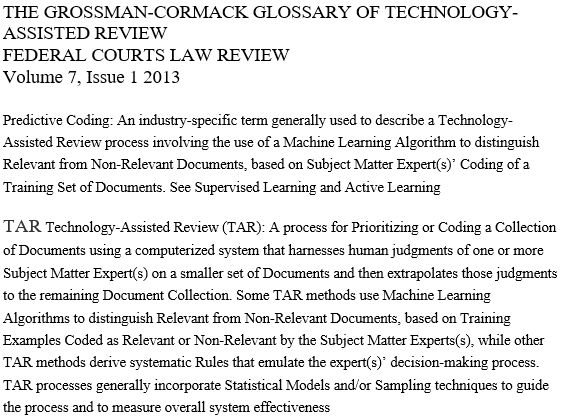
An industry-specific term generally used to describe a Technology-Assisted Review process involving the use of a Machine Learning Algorithm to distinguish Relevant from Non-Relevant Documents, based on a Subject Matter Expert’s Coding of a Training Set of Documents

But before long, the definition began to erode and TAR started to become synonymous with Predictive Coding. Why?  For several reasons I believe.

  1. The Grossman-Cormack glossary of 2013 used the phrase Coding” to define both TAR and PC and I think various parties then conflated the two. (See No. 2 below)

  1. Continued use of the terms interchangeably. See EG, Ralph Losey’s TARCourse,” where the very beginning of the first chapter states, “We also added a new class on the historical background of the development of predictive coding.”  (which is, by the way, an excellent read).
  2. Any discussion of TAR involves selecting documents using algorithms and most attorneys react to math the way the Wicked Witch of the West reacted to water.

Again, Ralph Losey provides a good example.  (I’m not trying to pick on Ralph, he is just such a prolific writer that his examples are everywhere…and deservedly so). He refers to gain curves, x-axis vs y-axis, HorvitsThompson estimators, recall rates, prevalence ranges and my personal favorite “word-based tf-idf tokenization strategy.”

“Danger. Danger. Warning. Will Robinson.”

  1. Marketing: the simple fact is that some vendors sell predictive coding tools. Why talk about other TAR tools when you don’t make them? Easier to call your tool TAR and leave it at that.

The problem became so acute that by 2015, according to a 2016 ACEDS News Article, Maura Grossman and Gordon Cormack trademarked the terms “Continuous Active Learning” and “CAL”, claiming those terms’ first commercial use on April 11, 2013 and January 15, 2014. In an ACEDS interview earlier in the year, Maura stated that “The primary purpose of our patents is defensive; that is, if we don’t patent our work, someone else will, and that could inhibit us from being able to use it. Similarly, if we don’t protect the marks ‘Continuous Active Learning’ and ‘CAL’ from being diluted or misused, they may go the same route as technology-assisted review and TAR.”

So then, what exactly is TAR? Everyone agrees that manual review is inefficient, but nobody can agree on what software the lawyers should use and how. I still prefer to go back to Maura and Gordon’s original definition. We’re talking about a process, not a product.

TAR isn’t a piece of software. It’s a process that can include many different steps, several pieces of software, and many decisions by the litigation team. Ralph calls it the multi-modal approach: a combination of people and computers to get the best result.

In short, analytics are the individual tools. TAR is the process you use to combine the tools you select.  The next consideration, then, is how to make that selection.

We’ll publish Part 3 – Uses for TAR and When to Use or Not Use It – next Tuesday.

So, what do you think?  How would you define TAR?  And, as always, please share any comments you might have or if you’d like to know more about a particular topic.

Image Copyright © Mars, Incorporated and its Affiliates.

Sponsor: This blog is sponsored by CloudNine, which is a data and legal discovery technology company with proven expertise in simplifying and automating the discovery of data for audits, investigations, and litigation. Used by legal and business customers worldwide including more than 50 of the top 250 Am Law firms and many of the world’s leading corporations, CloudNine’s eDiscovery automation software and services help customers gain insight and intelligence on electronic data.

Disclaimer: The views represented herein are exclusively the views of the author, and do not necessarily represent the views held by CloudNine. eDiscovery Daily is made available by CloudNine solely for educational purposes to provide general information about general eDiscovery principles and not to provide specific legal advice applicable to any particular circumstance. eDiscovery Daily should not be used as a substitute for competent legal advice from a lawyer you have retained and who has agreed to represent you.

Chris Dale of the eDisclosure Information Project: eDiscovery Trends 2018

This is the eleventh (and final) of the 2018 Legaltech New York (LTNY) Thought Leader Interview series.  eDiscovery Daily interviewed several thought leaders at LTNY this year (and some afterward) to get their observations regarding trends at the show and generally within the eDiscovery industry.

Today’s thought leader is Chris Dale.  Chris is Editor of the eDisclosure Information Project.  Chris qualified as an English solicitor in 1980. He was a litigation partner in London and then a litigation software developer and litigation support consultant before turning to commentary on electronic disclosure / discovery. He runs the e-Disclosure Information Project which disseminates information about the court rules, the problems, and the technology to lawyers and their clients, to judges, and to suppliers. He was a member of Senior Master Whitaker’s Working Party which drafted Practice Direction 31B and the Electronic Documents Questionnaire. Chris is also a well-known speaker and commentator in the UK, the US and other common law jurisdictions.

{I spoke to Chris during LTNY and this is a rough transcript of our discussion}

Everybody over here in the US is talking about the General Data Protection Regulation (GDPR), what it will mean to American businesses and especially the potential of large fines for lack of compliance.  What are people saying about it in Europe?  Is this as big a deal as everyone is making it out to be?

I’m plotting with somebody to have a conference in London before the implementation date, at which we will not mention the GDPR in the marketing profile.  Whether we’ll get that through the marketing department or the education department I have yet to find out, but there’s no doubt that GDPR is driving a lot of attention, often for the wrong reasons.

You say for the wrong reasons? Why do you say that?

A lot of people are talking about the 4% fines as if that was the only driver which matters. There are lots of people who are talking about “citizens” but have not responded to my challenge find the word ”citizens” anywhere in the GDPR. There’s a lot of pig ignorance about precisely what it says and what its terminology is, let alone what its effect is likely to be. That’s quieting down and the shouters are beginning to shout a bit less about 4% fines. Of course, the fines have to be mentioned, because they are part of the bottom line, and companies like Facebook may well face the very big fines. As a motive for doing anything about GDPR, they should not be the most compelling one for most companies.  It would be good to see people taking a more rounded approach to what the implications are. I interviewed someone this morning who is very good, very knowledgeable about it and yet he (to my surprise) mentioned the 4% fine.  But when we discussed the fine, it was clear that he didn’t mean everybody is at a risk from that. It would be good to see people produce a business case for dealing with GDPR that doesn’t refer either to the 4% fine or to “citizens”, because there’s a lot of nonsense going on about it at the moment. There are an awful lot of people who act as experts on it, but whose first paragraph about it betrays the fact that they haven’t got a clue.  I saw an article promoting a service just recently and the first paragraph had a gross error in it.

So, I guess it’s an understatement to say there’s a lot of misconceptions about the GDPR?

Yes. One of the results of that, to some extent anyway, is that companies just throw their hands up in horror and say, “Well, I can’t comply by the due date, so I’ll just hide and pretend it’s going to go away.” That’s the result of hype and what happens when providers raise the stakes. We saw it in Zubulake and we saw it with the federal changes way back. People are thinking, “Well I can’t comply with it anyway, so why bother?” And that is not exactly the right attitude.

There are people who talk about the 72-hour deadline for breach notification as if that meant you have to do everything, produce every last bit of information to a regulator and possibly to the people affected within the 72 hours.  All this hype tends to make a lot of organizations say, “I can’t, I know I don’t comply with that anyway, I’ll just keep my head down, hope they hit somebody else.” Whereas there needs to be a more moderated approach to what needs to be done and what the implications are of not doing it, and a more positive look at what you gain from compliance.

My favorite quotation came from a chap called Patrick Burke whom you may know. He was in private practice advising on privacy and data protection, and specifically on the GDPR, and I asked him, “What’s your clients’ reactions, are they in fear of fines?” He said, “No, they just want to keep doing business.” Which is a really good line. Very quickly, the clients of the organizations who haven’t complied are probably going to start putting it into their RFP. They’ll be asking not just, “Have you complied?” but ”Can you indicate what you have done to be consistent with compliance with GDPR?” Those who have to say, “Oh, I don’t know what you’re talking about,” which I’m afraid includes quite a lot, will start losing business.  Possibly the companies who are asking that themselves won’t be compliant or know what it means, but it’ll become one of those tick box items like so many other things and the inability to give a satisfactory answer will lose business.

If you look at one of the companies in the UK that’s been fined under the present regime, they were fined 400,000 pounds, which sounds a lot of money until you look at what else they lost – £80 million in direct and indirect costs. It is said that they lost more than 6% of their market share, so you could multiply that £400,000 fine by roughly ten times under the new regime and you’re still not scratching the surface of the losses they’ve suffered overall, because they come across as the sort of company that doesn’t look after its customers’ data properly.

The conventional marketing of, “I know GDPR and I can help you through it,” doesn’t scratch the surface particularly if they start using terminology that doesn’t actually exist in it.  But you’re not offering expert services in guidance through the GDPR, you’re offering the ability to do specific things like to identify personal data and believing it is somebody else’s problem perhaps to decide what personal data is and what the risk profile is. Stick resolutely to the provision of services to meet whatever requirements are offered are sought, such as the ability to identify personal data and the ability to adapt, to show what data you’ve got in case you need to do so.

Perhaps that doesn’t matter as long as one gets business from it.  There’s certainly a lot of work coming out of it. Maybe we are at last finding the ROI for information governance that was missing on the first round through IG. Maybe people will begin to realize that if they get rid of their “crap”, they have less of a problem. That’s valuable.  The end result is less crap, or at least a better handle on their crap through data maps and things like that.  And knowing where it is from the moment of its creation and what in it might be offensive – knowing what ought to be deleted.

Or at least confront the decision. “Yes, I ought to delete that because the EU rules say that once it’s no longer serving the purpose for which it was collected it ought to be deleted.” Weighing that against, “Yes, but then I might be in trouble with a US regulator or court.”  It’s about making the informed decision that you’re keeping it or not keeping it, depending on which of those risks you see as the most important.  We will see gradually US courts acknowledging that there’s an EU requirement to delete data – if it contains personal information that’s no longer required for the purpose for which it was collected –and to acknowledge that that is a reason, an excuse if you like, for its non-availability.

That will take three to five years. For a period you’ll have judges who either don’t give a damn what everybody outside the US says or are too uninformed to understand what all this means with arguments put in front of them by lawyers who neither care nor understand what it all means.  But you’ll reach a point where I think the US courts will acknowledge that there are problems for those who keep EU data at the rate it that has been done most times in the EU. All that will take time and I hope there’ll be some examples. There’ll be some people who get some serious difficulties because of failure to comply. We don’t wish bad things for those people, but until we start seeing that we don’t actually know what target we’re aiming for. Regardless how well we might think we understand the statutes until we start seeing how regulators enforce them, we won’t know what to expect.  Of course, whether we get consistency between EU regulators (as is the hope) or whether in fact they all end up with different shades of interpretation will make a difference. It will take time and very interesting to see. That problem makes it sound even more daunting than it was.

In addition to GDPR, the Supreme Court decision in the Microsoft Ireland case will also have an impact of privacy rights for data subpoenaed by US law enforcement agencies.  What do you think will happen there and what do you think will be the impact?

I think it’s likely that Judge Francis’ original opinion is upheld by the Supreme Court. I think it will be upheld because the politics of it is not Supreme Court’s concern. It will be interesting to see what will happen when the Supreme Court says, “Yes, it’s absolutely fine for US agencies to dip their hands into data stores all over the world even if they don’t know that it’s a US citizen.” That’s a perfectly possible outcome.  What are you going to do then? What’s China going to do? There’s all these sort of political things, which as I say are not strictly the concern of the Supreme Court. What’s the backlash going to be?  Nobody knows.

Regardless of what the decision ultimately is, the CLOUD Act currently before Congress (to amend the Stored Communications Act to allow US federal law enforcement to compel U.S.-based service providers via warrant or subpoena to provide requested data stored on servers regardless of whether they are located within the U.S. or in foreign countries) could make the Supreme Court decision moot.  {Editor’s Note: The CLOUD Act was signed into law as part of the Omnibus Bill in March.}

What would you like our readers to know about things you’re working on?

We have some new civil discovery rules pending in England and Wales, and we have had some cases worthy of comment recently. The main thing is to keep writing – I’m getting 60 more page views per day this year than last year (that is, nearly 22,000 extra page views a year) which suggests a growing interest in this subject.

Part of that, perhaps, is down to the videos which we do and I am keen to make more use of this medium to get messages across, whether about the rules of England and Wales, the GDPR, or the interesting developments in discovery US and worldwide. They are very time-consuming to do properly but are well worth it.

Thanks, Chris, for participating in the interview!

As always, please share any comments you might have or if you’d like to know more about a particular topic!

Sponsor: This blog is sponsored by CloudNine, which is a data and legal discovery technology company with proven expertise in simplifying and automating the discovery of data for audits, investigations, and litigation.  Used by legal and business customers worldwide including more than 50 of the top 250 Am Law firms and many of the world’s leading corporations, CloudNine’s eDiscovery automation software and services help customers gain insight and intelligence on electronic data.

Disclaimer:  The views represented herein are exclusively the views of the author, and do not necessarily represent the views held by CloudNine.  eDiscovery Daily is made available by CloudNine solely for educational purposes to provide general information about general eDiscovery principles and not to provide specific legal advice applicable to any particular circumstance.  eDiscovery Daily should not be used as a substitute for competent legal advice from a lawyer you have retained and who has agreed to represent you.