eDiscoveryDaily

Is the eDiscovery Market Growing or Shrinking? Or Maybe SHIFTING?: eDiscovery Trends

If you look at the number of eDiscovery companies that have been merged or acquired over the past couple of years, you might think that the market is shrinking.  On the other hand, if you look at the number of venture capital firms investing in the industry and the number of new startups, you might think that the market is growing.  So, which is it?

According to the ABA Journal (Market to manage electronic documents in a state of flux, written by Jason Krause), more than 30 major eDiscovery companies were acquired or merged, or they disappeared.  But at the same time, venture capital firms poured millions of dollars into startups and upstart companies offering technology to manage electronic documents in litigation.  So, with regard to whether the eDiscovery market is growing or shrinking, maybe it’s a bit of both.

Jason’s article observes that “Large corporate clients are resistant to paying millions for litigation support services when a lawsuit arises. Rather, large organizations are investing in tools to manage electronic records before litigation ever happens.” “E-discovery revenue streams and technology are opening up opportunities for companies with a focus on data from the point of creation, rather than just from the point of a legal trigger event,” says (my colleague) Rob Robinson, who (if you read our blog regularly, you already know this) tracks industry investment activity and conducts a quarterly eDiscovery business confidence survey on his excellent website Complex Discovery.

So, maybe it’s not so much that the market is shrinking or growing, as much as it’s shifting.  Hmmm…

Jason points to industry estimates as an example that the eDiscovery market isn’t as lucrative, noting that “analysts at IDC Research claimed the e-discovery industry earned $9.7 billion in revenues in 2006 and predicted they would explode and hit $21.8 billion by 2011. But last year, IDC published a new set of figures. It said the industry had only just surpassed $10 billion in revenues, making a much more modest prediction of $14.7 billion in revenue by 2019.”

Jason points to the revised Federal Rules of Civil Procedure as one potential cause for weakened demand from clients, particularly Rule 37(e) and the reduced likelihood for significant sanctions – due in large part to the new “intent to deprive” standard to be met for significant sanctions to be administered.  He notes that, because of the rule change, clients “are less terrified of sanctions and less willing to spend big bucks on a service provider who will collect and process massive data sets.”  That, in turn, is leading to consolidating of “old-line e-discovery vendors”, like the LDiscovery $410 million acquisition of Kroll Ontrack in October of last year and the $240 million merger of OpenText and Guidance Software in July of this year.

To me, the other factor of change in that equation is automation – we’re seeing automation technology increasingly being applied to both collection and processing, reducing the requirement for the professionals that used to perform those services.  At least to a degree, eDiscovery revenue is shifting from services to software (though there is still a need for certain services) and automation and cloud technologies are continuing to make those services more affordable.

However, given the fact that data within organizations is doubling every 1.2 years (but budgets aren’t) and also given how many sources of data there are to manage these days, organizations still have a challenge – how to manage the growing volume and variety of data within the organization to meet the information needs for that organization.  As a result, I think we’re seeing a shift (there’s that word again) in focus to the left side of the EDRM model and Information Governance.  The need to gain insight into an organization’s data will continue to be strong, regardless of current sanctions rules regarding data spoliation.  Maybe that’s one reason why all those venture capital firms are investing – not just for the growth in the eDiscovery market, but also the growth in the InfoGov market as well where many of the same software and services can be applied.  When you put both of them together, the future (in my opinion) is still bright.  I shift you not.  :o)

So, what do you think?  Is the eDiscovery market growing or shrinking?  As always, please share any comments you might have or if you’d like to know more about a particular topic.

Disclaimer: The views represented herein are exclusively the views of the author, and do not necessarily represent the views held by CloudNine. eDiscovery Daily is made available by CloudNine solely for educational purposes to provide general information about general eDiscovery principles and not to provide specific legal advice applicable to any particular circumstance. eDiscovery Daily should not be used as a substitute for competent legal advice from a lawyer you have retained and who has agreed to represent you.


After Objection, No Waiver of Privilege for Putting Information on File Share Site without Protection: eDiscovery Case Law

In Harleysville Insurance Co. v. Holding Funeral Home, Inc., No. 1:15cv00057 (W.D. Va. Oct. 2, 2017), Virginia District Judge James P. Jones sustained the plaintiff’s objections to the Magistrate Court ruling that the plaintiff’s placement of privileged information on a file share site and distribution of the hyperlink to access that information without providing any protection for the site resulted in a failure to take reasonable steps to protect the information.  As a result, for their “improper” conduct in failing to promptly return the materials, the defendants received an evidentiary sanction, barring their use of the inadvertently disclosed privileged materials.  Judge Jones overruled the plaintiff’s objection to the decision not to disqualify defense counsel, stating he was “not convinced that the ‘blunt remedy of disqualification is appropriate.’”

Case Background

In this dispute over a fire insurance claim by the defendants against the plaintiff insurance agent, a senior investigator for Nationwide Insurance, owner of the plaintiff company, uploaded surveillance footage to a file share service operated by Box, Inc. and sent an email containing a link to the site to an investigator at the National Insurance Crime Bureau (“NICB”) in September 2015.  The email contained a confidentiality notice indicating that the “e-mail contains information that is privileged and confidential”, but the information on Box was not password protected.  For a while, only the video was available on the Box site, but in April 2016, the Nationwide investigator placed files containing the plaintiff’s entire claims file and Nationwide’s entire investigation file for the defendants’ fire loss on the Box Site to be accessed by the plaintiff’s counsel – a month later, in response to a subpoena, the NICB electronically produced its files – including the email containing the link – to the defense counsel, which gave them access to the file share site containing the claims files.

Defense counsel subsequently accessed the site and reviewed and downloaded the entire claims file, but did not notify the plaintiff’s counsel that it had accessed the information until plaintiff’s counsel discovered the claims file included in materials produced by the defense in October 2016.  As a result of this discovery, the plaintiff moved to disqualify defense counsel; in response, they argued that that the motion should be denied because the plaintiff “waived any claim of privilege or confidentiality by placing the information on the Box, Inc., site where it could be accessed by anyone.”  Magistrate Judge ruled that Pamela Meade Sargent, determining that “Rule 502 does not apply in this situation to prevent a waiver of the work-product doctrine”, concluded that the plaintiff waived any claim of privilege or work-product protection over its Claims File.  She also declined to disqualify defense counsel, but ruled that they should bear the cost of the parties in obtaining the court’s ruling on the matter.  The plaintiff’s objected to both rulings.

Judge’s Ruling

Noting that “the magistrate judge did not have the benefit of reviewing the Claims File” and that “it is within my discretion to receive and consider additional evidence”, Judge Jones found that “the attorney-client privilege attaches to multiple documents contained in the Claims File”, calling them “the epitome of privilege.”  Judge Jones overruled the plaintiff’s objection to the magistrate court findings that the disclosure was inadvertent, leading to the consideration of three of five factors (Judge Jones agreed with the magistrate court that “Factors Three and Five have no applicability to this case”) to determine whether privilege had been waived:

(1) [T]he reasonableness of the precautions to prevent inadvertent disclosures, (2) the time taken to rectify the error and (4) the extent of the disclosure.

Noting that “the Box Folder was not searchable through Google or any other search engine, nor was it searchable on the Box, Inc. website” and that “as a practical matter, the [disclosed] URL itself functions as a password”, Judge Jones did “conclude that Nationwide, acting for Harleysville, did take reasonable precautions to prevent an inadvertent disclosure of the Claims File and that this factor weighs against a finding of waiver” and sustained the objection on reasonable precautions.  Judge Jones also observed that “Harleysville’s counsel were not notified of the disclosure until October 27, 2016” and “reached out to Insureds’ counsel to request destruction of the privileged materials on November 1, 2016” in sustaining the objection on time taken to rectify the error.  He also noted that the “disclosure in this case was not extensive” in sustaining that objection as well.

As for sanctions against defense counsel, Judge Jones found that “Insureds’ counsel had an obligation to ‘promptly return, sequester, or destroy’ the privileged materials, Fed. R. Civ. P. 45(e)(2)(B), with which they refused to comply.”  He also found that “Insureds’ counsel had a duty to uphold the integrity of the legal profession and to strive to avoid impropriety, as well as the mere appearance of impropriety” and that they “failed to do so”.  However, noting that “the mistakes by Nationwide’s employee initiated this issue”, Judge Jones declined to disqualify defense counsel, stating that “I am not convinced that the ‘blunt remedy of disqualification is appropriate.’”  Instead, Judge Jones found that “an evidentiary sanction is appropriate”, ruling that “the Insureds must not use any information contained in the privileged material, or information derived from such material, to seek additional information in discovery, through a subpoena, or in any other manner. Moreover, the Insureds must not use the information contained in or derived from the privileged material for any purpose in any filing or proceedings (including trial) in this action or any other related civil action.”

We covered the case previously here and Tom O’Connor and I also discussed it in a webcast as one of the key eDiscovery cases in the first half of 2017 here.

So, what do you think?  Was the first ruling right in waiving privilege or the second one right in determining that privilege was not waived?  Please share any comments you might have or if you’d like to know more about a particular topic.

Case opinion link courtesy of eDiscovery Assistant.

Disclaimer: The views represented herein are exclusively the views of the author, and do not necessarily represent the views held by CloudNine. eDiscovery Daily is made available by CloudNine solely for educational purposes to provide general information about general eDiscovery principles and not to provide specific legal advice applicable to any particular circumstance. eDiscovery Daily should not be used as a substitute for competent legal advice from a lawyer you have retained and who has agreed to represent you.
IT Will Scare You – eDiscovery Horrors!

Today is Halloween!  Hard to believe, but for eight years now, we have identified stories to try to “scare” you with tales of eDiscovery and cybersecurity horrors because we are, after all, an eDiscovery blog.  Let’s see how we do this year.  Will IT scare you?

Evidently, until just a few days ago, this firm failed to acknowledge a data breach that occurred last year (involving some of Britain’s wealthiest people) until international journalists had a chance to see the leaked information.

What about this?

More rich people compromised.  When you’re a lawyer and you find out that you’ve inadvertently produced client confidential information in litigation, it’s a bad day. When you find out that confidential information is personal information on thousands of the wealthiest investors in your client’s portfolio, it’s an even worse day. And, when you find out that disclosure is being covered by The New York Times, it’s a lawyer’s worst nightmare.

Or this?

Did you know that everything you’ve learned about how to create secure passwords for the past few years is wrong?

How about this?

You probably think that using three different evidence wiping programs before turning over a laptop for inspection will certainly lead to sanctions for spoliation.  Not necessarily.

Or maybe this?

Think data breaches are expensive?  Try this one.  A major data breach cost this health insurance provider over $100 million to settle the class-action lawsuit against it.

Have you considered this?

On this Halloween, a real tale of murder (no joke) and how the victim’s Fitbit may have blown her husband’s story of what happened apart.  Then again, maybe it’s not so surprising, considering how much data each of us generates every minute.

Finally, how about this?

If you want to fire a whistleblower and then put together a bad performance review of him afterward, it could cost you $10.8 million.

Scary, huh?  If the possibility of expensive data breaches, embarrassing inadvertent disclosures and more data being tracked about you than ever scares you, then the folks at eDiscovery Daily will do our best to provide useful information and best practices to enable you to relax and sleep soundly, even on Halloween!

Of course, if you seriously want to get into the spirit of Halloween and be scared, check out this video about some clown in the IT department.  This will really terrify you!

What do you think?  Is there a particular eDiscovery issue that scares you?  Please share your comments and let us know if you’d like more information on a particular topic.

Happy Halloween!  And, Go Astros!

Disclaimer: The views represented herein are exclusively the views of the author, and do not necessarily represent the views held by CloudNine. eDiscovery Daily is made available by CloudNine solely for educational purposes to provide general information about general eDiscovery principles and not to provide specific legal advice applicable to any particular circumstance. eDiscovery Daily should not be used as a substitute for competent legal advice from a lawyer you have retained and who has agreed to represent you.

Last Year the Panama Papers, This Year the Bermuda Briefs?: Cybersecurity Trends

Last year, we covered the massive data breach at Panama-based law firm Mossak Fonseca (11.5 million documents, 2.6 total TB – yes, terabytes – of data stolen) that has come to be known as the “Panama Papers”.  Now, a Bermuda law firm has finally admitted to a data breach that evidently occurred last year.

According to The Register (Panic of Panama Papers-style revelations follows Bermuda law firm hack, written by John Leydon), Bermuda-based firm Appleby only admitted it had suffered the breach – which actually happened last year – after a group of journos from the International Consortium of Investigative Journalists (ICIJ), who had seen the leaked information, began asking awkward questions.

In a statement, Appleby denied allegations of any tax evasions or other wrongdoing by itself or its clients while admitting that it was “not infallible”. The law firm went on to state that it had shored up its security since the hack, stating “We are committed to protecting our clients’ data and we have reviewed our cyber security and data access arrangements following a data security incident last year which involved some of our data being compromised. These arrangements were reviewed and tested by a leading IT Forensics team and we are confident that our data integrity is secure.”

The Daily Telegraph (subscription required) reported that the leak involved some of Britain’s wealthiest people, who were said to be consulting lawyers and public relations executives in preparations for possible fallout from the hack.

Hat tip (as always) to Ride the Lightning, who noted that Appleby employs 470 staffers and operates from 10 offices across the world. It has stated that it offers services to global public and private companies, financial institutions as well as “high net worth individuals.”

It seems like a lot of “high net worth individuals” are getting their information stolen these days.  As Willie Sutton was reported to have said about why he robbed banks (though he denied saying it in later years) – because that’s where the money is.  Glad I don’t have that problem!  ;o)

BTW, if the term “Bermuda Briefs” takes off, you heard it here first…

So, what do you think?  What should happen to a law firm (or any organization) that fails to report a data breach in a timely manner?  As always, please share any comments you might have or if you’d like to know more about a particular topic.

Disclaimer: The views represented herein are exclusively the views of the author, and do not necessarily represent the views held by CloudNine. eDiscovery Daily is made available by CloudNine solely for educational purposes to provide general information about general eDiscovery principles and not to provide specific legal advice applicable to any particular circumstance. eDiscovery Daily should not be used as a substitute for competent legal advice from a lawyer you have retained and who has agreed to represent you.

The Relativity Conference was “Fest-ive” This Year: eDiscovery Trends

As I’ve noted for most of the week, Relativity Fest ’17 was held this week in Chicago at The Hilton Chicago.  Having not been to a Relativity Fest before, it was an eye opening experience.  Here are a few of the highlights.

Attendee Breakdown: According to the opening keynote (below), there were 1,003 Litigation Support attendees, 232 IT & Security attendees, 224 “Executives”, 148 Attorneys, 135 Sales and Marketing attendees, 80 Paralegals, 58 Developers, 31 Academics, 19 Press and Analysts attendees and 4 Judges (see below for those) for a total of 1,934 attendees overall.

Opening Keynote on Monday Morning: In a style and size similar to an Apple product launch, Andrew Sjeja (Founder and CEO of Relativity) kicked off the main conference with an opening keynote address that discussed the conference and (of course) covered key Relativity current and upcoming features.  As part of the 90+ minute(!) presentation, Andrew called up several clients to discuss their case study experiences with various Relativity features.  Here’s a pic of Andrew on the massive stage (I was too close to the front to get all of it):

Judicial Panel on Monday Afternoon: Not surprisingly, this panel – moderated by David Horrigan, e-Discovery Counsel and Legal Content Director at Relativity, along with Judge Nora Barry Fischer of the Western District of Pennsylvania, Judge Andrew Peck of the Southern District of New York, Judge Xavier Rodriguez of the Western District of Texas and Justice Peter Vickery of the Supreme Court of Victoria in Australia – did not disappoint.  The panelists discussed their opinions on several cases, including the spoliation case involving Taylor Swift, the Texas Supreme Court decision involving State Farm and the dispute over form of production, the murder cases involving evidence from IoT devices Amazon Echo and Fitbit, a discussion of the state of Technology Assisted Review and, of course, the ubiquitous advice from Judge Peck to always get a 502(d) non-waiver of privilege order.  Here’s a pic of that panel:

ACEDS Happy Hour on Monday Evening: ACEDS had a terrific happy hour on Monday, gave a shout out to Tom O’Connor on his birthday, and I visited with everybody from my CloudNine colleagues to Kelly Twigger to Bill Hamilton to Andy Sjeja to Tom and Gayle O’Connor to David Horrigan to George Socha to Jim Gill.  I’m sure I’m missing a few names.  But, getting a chance to better know your colleagues is always fun!

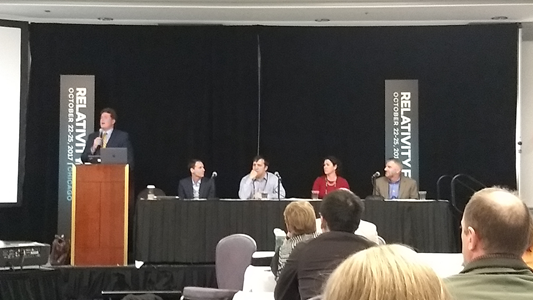
eDiscovery in the Cloud Panel on Tuesday Morning: You didn’t think I was going to forget the panel I was on, did you?  The session was moderated by David Horrigan of Relativity and we were joined by Ari Kaplan, Principal at Ari Kaplan Advisors, Kelly Twigger, Founder of ESI Attorneys and Rachi Messing, Senior Program Manager at Microsoft.  Rachi’s name is pronounced like “Rocky” and the hotel must have thought the real “Rocky was there because the temperature was like a meat locker in our session!  Anyway, we talked about a variety of topics, ranging from defining different types of cloud implementations to using the cloud to security and privacy in the cloud (spent a lot of time there, especially given the recent cases involving Microsoft).  Zach Warren of LegalTech News wrote an article about our session here (free subscription required), which I appreciate (even though there’s a typo in one of my quotes – see if you can find it!) and I was honored and excited to be part of the panel discussion.  Here’s a pic of us:

A Practical Roadmap for EU Data Protection and Cross-Border Discovery on Tuesday Afternoon: Presented by Jason Priebe and Natalya Northrip of Seyfarth Shaw.  With only about 7 months to go before General Data Protection Regulation (GDPR) hits on May 25 of next year, the presenters provided a very thorough discussion of the differences between the EU Data Privacy Directive and the GDPR, the requirements for GDPR, privacy rights under GDPR, requirements for a Data Protection Officer (DPO) and how (of course) GDPR will affect cross-border discovery.

Extra Stuff: Relativity provided breakfast and lunch each day and also hosted a terrific speakers’ dinner on Monday night.  From what I understand, their networking event/party on Tuesday night at the Museum of Science and Industry was a blast!  Sadly, I had to leave to come back to Houston to do a webcast on Wednesday (which is also why I don’t have any Wednesday highlights).

Suggestions for Improvement: The sessions were great, but it would be great to allow a little more time in between sessions to get to the next one.  Fifteen minutes is not a lot of time when the previous session runs long AND you need to take a bio break AND you have no idea where the next session is.  Which leads me to my next suggestion: please post the floor number next to the name of the room to help us locate the session room more quickly.  Sessions were on at least four different floors and were sometimes difficult to find.  Minor gripes in an otherwise excellent conference.

As a development partner in the Relativity ecosystem, CloudNine was at the conference and was there to provide demonstrations of our Outpost for Relativity that automatically ingests and loads data into Relativity based on your specified criteria.  If you missed it and would like a demo, please request one at info@cloudninedisco.wpengine.com.

So, what do you think?  Did you attend Relativity Fest this year?  If so, what did you think?  As always, please share any comments you might have or if you’d like to know more about a particular topic.

Also, I’m excited to report that eDiscovery Daily has been nominated to participate in The Expert Institute’s Best Legal Blog Contest in the Legal Tech category!  Thanks to whoever nominated us!  We’re fading fast, but if you enjoy our blog, you can vote for it and still help it win a spot in their Best Legal Blogs Hall of Fame.  You can cast a vote for the blog here.  Thanks!

Disclaimer: The views represented herein are exclusively the views of the author, and do not necessarily represent the views held by CloudNine. eDiscovery Daily is made available by CloudNine solely for educational purposes to provide general information about general eDiscovery principles and not to provide specific legal advice applicable to any particular circumstance. eDiscovery Daily should not be used as a substitute for competent legal advice from a lawyer you have retained and who has agreed to represent you.

Houston, We Have a Problem – Court Specifies Jury Instructions to Address Spoliation Findings: eDiscovery Case Law

In GN Netcom, Inc. v. Plantronics, Inc., No. 12-1318-LPS (D. Delaware, Oct. 5, 2017), Delaware District Judge Leonard P. Stark chose to determine the preliminary and final jury instructions he would give with respect to the defendant’s spoliation for the “intentional and admitted deletion of emails” ruled on earlier, as well as the “Stipulated Facts” he would read to the jury at or near the start of the trial, rather than respond to the four spoliation-related questions posed by the plaintiff or defendant.

In this case with claims of monopolization, attempted monopolization and common-law tortious interference with business relations against the defendant, the defendant received “punitive sanctions in the amount of $3,000,000” for the “intentional and admitted deletion of emails” by the defendant’s Senior Vice President of Sales.  After reviewing the parties’ joint status report, as well as other materials submitted throughout the case, and having discussed the issues with the parties on multiple occasions, including during the pretrial conference, Judge Stark chose to determine the preliminary and final jury instructions he would give, as well as the “Stipulated Facts” he would read to the jury at or near the start of the trial.

Judge Stark identified this language as the “preliminary instruction {that} will be provided to the jury”:

“SPOLIATION

The law requires that parties preserve relevant documents, including emails, when litigation is pending or contemplated. This is because, when one party sues another, each side has the right under the law to inspect or obtain production of internal documents and other evidence from the other party.

The destruction or material alteration of evidence or the failure to preserve documents or emails for another party’s use as evidence in pending or reasonably foreseeable litigation is referred to as “spoliation.”

In this case, it has been determined that Plantronics committed spoliation.

It has also been determined that Plantronics’ spoliation was not accidental and that evidence relevant to this case may have been destroyed by Plantronics. As such, during this trial, you may hear questions and answers from the parties referencing missing or destroyed emails and Plantronics’ spoliation of evidence. While the exact contents of the spoliated evidence are unknown, you, the jury, will be permitted – but not required – to infer that the lost documents were relevant and favorable to GN’s case and/or harmful to Plantronics’ case.

*3 You will learn during trial that Don Houston, a former employee at Plantronics, failed to preserve certain emails after his duty to preserve them arose. You will also hear that efforts were made to recover the emails that Mr. Houston failed to preserve and that additional emails were produced to GN through these recovery efforts.

I will have further instructions on these matters for you at the conclusion of the trial.”

Judge Stark identified this language as the “final instruction {that} will be provided to the jury”:

“SPOLIATION

I instruct you that Plantronics failed to preserve evidence after its duty to preserve arose. This failure to preserve is known as ‘spoliation of evidence.’ In other words, spoliation is the destruction or material alteration of evidence or the failure to preserve evidence for another’s use in pending or reasonably foreseeable litigation.

Based on Plantronics’ spoliation, you may, but are not required, to presume that the lost evidence would have been relevant and helpful to GN’s case and/or would have been harmful to Plantronics’ case. Alternatively, you may infer that the evidence not produced would merely have been duplicative of, or similar to, the evidence before you.

In other words, your role is to determine whether Plantronics’ spoliation tilted the playing field against GN. If so, the permission given to you by the Court to infer that the missing documents would have been relevant and helpful to GN and/or harmful to Plantronics is designed to allow you to balance that playing field, should you feel it is necessary.

It is up to you to decide the extent to which the lost evidence was relevant and helpful to GN and/or harmful to Plantronics. Of course, it is impossible to know exactly what evidence was lost – although the parties have tried – so you must make these determinations to the best of your ability based on all of the facts and circumstances of this case. You must then decide how much weight and effect to give to your belief about spoliation in reaching your verdict.”

Judge Stark also identified the 16 stipulations that he would read.  Four of those stipulations would only be read “if, no later than Saturday, October 7 at 3:00 p.m., Plantronics submits an affidavit providing the evidentiary basis for the numerical figures contained in these paragraphs, all of which the Court adopted based on Plantronics’ representations.”

So, what do you think?  Is a jury instruction a sufficient sanction for the “intentional and admitted” spoliation by the defendant?  Please share any comments you might have or if you’d like to know more about a particular topic.

Also, I’m excited to report that eDiscovery Daily has been nominated to participate in The Expert Institute’s Best Legal Blog Contest in the Legal Tech category!  Thanks to whoever nominated us!  We’re fading fast, but if you enjoy our blog, you can still vote for it and help it win a spot in their Best Legal Blogs Hall of Fame.  You can cast a vote for the blog here.  Thanks!

Case opinion link courtesy of eDiscovery Assistant.

Disclaimer: The views represented herein are exclusively the views of the author, and do not necessarily represent the views held by CloudNine. eDiscovery Daily is made available by CloudNine solely for educational purposes to provide general information about general eDiscovery principles and not to provide specific legal advice applicable to any particular circumstance. eDiscovery Daily should not be used as a substitute for competent legal advice from a lawyer you have retained and who has agreed to represent you.

Today’s the Day to Learn How to Avoid the eDiscovery Disasters of Other High Profile Organizations: eDiscovery Best Practices

The recent eDiscovery failures at Wells Fargo and at the Department of Justice show that eDiscovery mistakes and failures happen even at the largest corporations and government agencies.  Today, you have a chance to learn from their mistakes.

Today at noon CST (1:00pm EST, 10:00am PST), CloudNine will conduct the webcast Lessons Learned from Recent eDiscovery Disasters. In this one-hour webcast that’s CLE-approved in selected states, we will discuss the various issues that occurred in these high-profile cases and what to do to avoid them in your own cases.  Topics include:

  • Attorney Duty of Competence
  • Managing Communications: Attorney Responsibilities
  • Managing Communications: Vendor Responsibilities
  • Recommended Workflows for Tracking Review
  • Common Redaction Mistakes and How to Avoid Them
  • Checking for Personally Identifiable Information (PII)
  • Key Takeaways for Better eDiscovery Project Management

I’ll be presenting the webcast, along with Tom O’Connor, who is a Special Consultant to CloudNine.  I’m excited to once again have Tom as a participant in this webcast!  To register for it, click here.  Even if you can’t make it, go ahead and register to get a link to the slides and to the recording of the webcast (if you want to check it out later).  It just might keep you from being mentioned in The New York Times – and not in a good way).

Also, I’m excited to report that eDiscovery Daily has been nominated to participate in The Expert Institute’s Best Legal Blog Contest in the Legal Tech category!  Thanks to whoever nominated us!  If you enjoy our blog, you can vote for it and help it win a spot in their Best Legal Blogs Hall of Fame.  There’s just a few days left to vote, but you can cast a vote for the blog here.  Thanks!

So, what do you think?  Do you know any other eDiscovery “epic fail” stories?  Please share any comments you might have or if you’d like to know more about a particular topic.

Disclaimer: The views represented herein are exclusively the views of the author, and do not necessarily represent the views held by CloudNine. eDiscovery Daily is made available by CloudNine solely for educational purposes to provide general information about general eDiscovery principles and not to provide specific legal advice applicable to any particular circumstance. eDiscovery Daily should not be used as a substitute for competent legal advice from a lawyer you have retained and who has agreed to represent you.

eDiscovery in the Cloud: eDiscovery Best Practices

Relativity Fest started on Sunday and CloudNine is there.  As part of the team, I will be there covering the conference for eDiscovery Daily and will speaking(!) today.  Click here to see our post on some of the anticipated highlights from the conference.

Today’s highlight is my session: e-Discovery in the Cloud, today at 11:00 am, moderated by David Horrigan, e-Discovery Counsel and Legal Content Director at Relativity and we will be joined by Rachi Messing, Senior Program Manager at Microsoft, Ari Kaplan, Principal at Ari Kaplan Advisors and Kelly Twigger, Founder of ESI Attorneys.  If you’re at the show today, come check it out!

Yesterday was a terrific day, starting with the keynote speech from Andrew Sieja, the CEO of Relativity and continuing with terrific sessions, including the The Judicial Panel, with David Horrigan of Relativity, along with Judge Nora Barry Fischer of the Western District of Pennsylvania, Judge Andrew Peck of the Southern District of New York, Judge Xavier Rodriguez of the Western District of Texas and (all the way from Australia) Justice Peter Vickery of the Supreme Court of Victoria (and the recent landmark TAR decision in that country) to discuss the latest legal developments in eDiscovery.

There were several other great sessions, an ACEDS happy hour and a speaker dinner, with an opportunity to have a great time with other speakers at the show!  Quite a day!  Hopefully, today will be as much fun as yesterday!

So, what do you think?  Are you attending Relativity Fest this year?  Please share any comments you might have or if you’d like to know more about a particular topic.

Also, I’m excited to report that eDiscovery Daily has been nominated to participate in The Expert Institute’s Best Legal Blog Contest in the Legal Tech category!  Thanks to whoever nominated us!  We’re fading fast, but if you enjoy our blog, you can still vote for it and help it win a spot in their Best Legal Blogs Hall of Fame.  You can cast a vote for the blog here.  Thanks!

Disclaimer: The views represented herein are exclusively the views of the author, and do not necessarily represent the views held by CloudNine. eDiscovery Daily is made available by CloudNine solely for educational purposes to provide general information about general eDiscovery principles and not to provide specific legal advice applicable to any particular circumstance. eDiscovery Daily should not be used as a substitute for competent legal advice from a lawyer you have retained and who has agreed to represent you.

Court Denies Default Judgment Sanctions for Defendant’s Production of Two Versions of Same Email: eDiscovery Case Law

But first, a reminder that Relativity Fest started yesterday and CloudNine is there.  As part of the team, I will be there covering the conference for eDiscovery Daily and will speaking(!) on Tuesday.  Click here to see our post on some of the anticipated highlights from the conference.  Today’s highlight is The Judicial Panel, today at 1:00pm, with David Horrigan of Relativity, along with Judge Nora Barry Fischer of the Western District of Pennsylvania, Judge Andrew Peck of the Southern District of New York, Judge Xavier Rodriguez of the Western District of Texas and (all the way from Australia) Justice Peter Vickery of the Supreme Court of Victoria (and the recent landmark TAR decision in that country) to discuss the latest legal developments in eDiscovery.

In Catrinar v. Wynnestone Communities Corp., et al., No. 14-11872 (E.D. Mich. Sept. 30, 2017), Michigan Magistrate Judge R. Steven Whalen denied the plaintiff’s Motion for Discovery Sanctions (requesting a default judgment) for fabricating and producing false evidence, finding that the defendant’s production of two versions of an email fail all four factors of the Harmon test applied by the court in this case to determine whether the defendant’s failure was due to willfulness, bad faith, or fault and whether the plaintiff was prejudiced by the defendant’s conduct, among other factors.

Case Background

In this case regarding the plaintiff’s claim against his former employer alleging violations of the Family Medical Leave Act (“FMLA”) as well as breach of contract and promissory estoppel, the centerpiece of the plaintiff’s Motion for Discovery Sanctions was an allegation that the defendants fabricated and produced false evidence in the case.  The allegation of false evidence stemmed from defendant Silverman’s apparent rewrite of an email originally sent on December 21, 2008, concerning an “E&S” Plan and whether Silverman was aware of the plan or authorized any amendments to the plan.  The original email, which the plaintiff referred to as ‘the real email,’ was written partially in Spanish; the second, which the plaintiff referred to as ‘the fake email,” elaborated more on Silverman’s lack of knowledge of any such plan.  Both emails were dated on December 21, 2008 and the plaintiff argued that the “fake email” fraudulently supported Silverman’s position that he did not authorize an amendment to the E&S Plan, and that the “real email” offered no such support.

The defendant conceded that the native Outlook email file of what the plaintiff referred to as the “fake email” showed that it was created in January 2012, not December 2008.  However, in Silverman’s declaration, he stated that he forwarded the December 2008 email to himself in January 2012 for the purpose of re-writing in English and elaborating on his original message, stating “The point of the two emails is the same.”

Judge’s Ruling

Judge Whalen stated: “The Court’s discretion is informed by the four-part test described in Harmon v. CSX Transportation, Inc…: (1) whether the party’s failure is due to willfulness, bad faith, or fault; (2) whether the adversary was prejudiced by the dismissed party’s conduct; (3) whether the dismissed or defaulted party was warned that failure to cooperate could lead to dismissal or entry of default judgment; and (4) whether less drastic sanctions were imposed or considered before dismissal or default judgment was ordered.”

Judge Whalen also noted that “In deciding whether to impose ‘the draconian sanction’ of default judgment, the first factor—the party’s willfulness or bad faith in failing to comply with a discovery order—looms large.”  Noting that “Plaintiff filed his complaint on May 9, 2014, about two years and four months after the ‘fake email’ was created”, Judge Whalen, while acknowledging that “the discrepancy between the two emails and Silverman’s explanation as to how the later email came to be created may undoubtedly be exploited to the Plaintiff’s advantage” in trial, nonetheless stated: “I do not find that Plaintiff has shown ‘willfulness, bad faith, or fault’ with respect to the creation of the 2012 email.”  Judge Whalen also found that the plaintiff failed to meet the second Harmon factor, determining that the plaintiff was not prejudiced due to the fact that an “extension of discovery cures any prejudice which might otherwise have occurred as the result of the delay in Defendants’ production of the emails.”  Judge Whalen also found that the third and fourth Harmon factors were also not met, stating: “Defendants have not been previously warned that a default judgment or other sanctions could be imposed for discovery violations, nor have any lesser sanctions been imposed.”  As a result, Judge Whalen denied the plaintiff’s Motion for Discovery Sanctions.

So, what do you think?  Was the defendant’s explanation for the second email plausible?  Please share any comments you might have or if you’d like to know more about a particular topic.

Also, I’m excited to report that eDiscovery Daily has been nominated to participate in The Expert Institute’s Best Legal Blog Contest in the Legal Tech category!  Thanks to whoever nominated us!  We’re fading fast, but if you enjoy our blog, you can still vote for it and help it win a spot in their Best Legal Blogs Hall of Fame.  You can cast a vote for the blog here.  Thanks!

Case opinion link courtesy of eDiscovery Assistant.

Disclaimer: The views represented herein are exclusively the views of the author, and do not necessarily represent the views held by CloudNine. eDiscovery Daily is made available by CloudNine solely for educational purposes to provide general information about general eDiscovery principles and not to provide specific legal advice applicable to any particular circumstance. eDiscovery Daily should not be used as a substitute for competent legal advice from a lawyer you have retained and who has agreed to represent you.

Google Requests Contempt Order For $10,000 Sanctions Per Day Against…Google: eDiscovery Case Law

But first, a reminder that Relativity Fest starts this Sunday and CloudNine will be there.  As part of the team, I will be there covering the conference for eDiscovery Daily and will speaking(!) on Tuesday.  Click here to see our post on some of the anticipated highlights from the conference.

Last month, we wrote that Google went 0 for 2 in August in its request for review of warrant cases related to the Stored Communications Act of 1986 (SCA) and the order to produce ESI stored internationally that is subject to warrants was upheld in both cases, including a ruling in the Northern District of California on August 14.  Now, Google has filed an instant motion asking the Court to: “a) hold Google in civil contempt of the August 14 order; b) impose sanctions of $10,000 for every day that Google fails to comply; c) stay those sanctions until seven business days after the Ninth Circuit affirms the Court’s order; and d) require Google to preserve any information in its possession that is subject to the search warrant.” As noted in California District Judge Richard Seeborg’s order, “the The terms of the proposed sanctions are similar to the terms of stipulations that Google and other companies have entered into with the government in similar cases in other jurisdictions.”

So, why did Google ask the Court to impose a daily sanction of $10,000 against Google?  Evidently, while the government and Google “agree that Google should be held in contempt of the August 14 order”, they “disagree, however, about the appropriate way to devise a sanction that will ensure Google’s compliance and about whether an evidentiary hearing is needed to conduct that inquiry effectively.”  The government argued that “an evidentiary hearing is needed to assess the equities at stake in this case properly and to devise an appropriate sanction”, while Google contended that there is “no need to develop a more substantial evidentiary record or to devise a more severe sanction than the $10,000 per day fine that Google has proposed.”  Google also noted that “this Court already found in the August 14 order that, ‘[i]n light of the Second Circuit decision in Microsoft and the absence of relevant Ninth Circuit precedent, Google’s diligent, good faith efforts to comply with current law do not warrant contempt at this stage of the proceedings.’”

In ruling on the dispute, Judge Seeborg stated: “Of the two sides, Google’s arguments are more persuasive…The government acknowledges that Google has a right to press its appeal; it is not arguing that Google must turn over the information now. Neither is it arguing—at least at present—that Google should be held in criminal contempt for its past behavior. Thus, the only question currently in need of answer is what sanction will secure Google’s prompt compliance with the August 14 order should its appeal fail.”  Judge Seeborg also noted that “Should Google prevail on appeal, the issue will be moot. If Google loses, it will be required to comply with the August 14 order or be subject to the sanctions imposed by this order. If, at that time, Google fails to turn over data the government believes Google previously possessed but did not preserve, the government can raise the issue and seek an appropriate remedy.”

Tip of the hat to ACEDS for the link to the latest order in this case.

So, what do you think?  Will Google win its appeal?  As always, please share any comments you might have or if you’d like to know more about a particular topic.

Also, I’m excited to report that eDiscovery Daily has been nominated to participate in The Expert Institute’s Best Legal Blog Contest in the Legal Tech category!  Thanks to whoever nominated us!  We’re fading fast, but if you enjoy our blog, you can vote for it and still help it win a spot in their Best Legal Blogs Hall of Fame.  You can cast a vote for the blog here.  Thanks!

Disclaimer: The views represented herein are exclusively the views of the author, and do not necessarily represent the views held by CloudNine. eDiscovery Daily is made available by CloudNine solely for educational purposes to provide general information about general eDiscovery principles and not to provide specific legal advice applicable to any particular circumstance. eDiscovery Daily should not be used as a substitute for competent legal advice from a lawyer you have retained and who has agreed to represent you.