Sanctions

eDiscovery Best Practices: Repairing a Corrupted Outlook PST File

 

We like to believe that there will never be any problems with the data that we preserve, collect and process for eDiscovery purposes.  Sometimes, however, critical data may be difficult or impossible to use.  Perhaps key files are password protected from being opened and the only way to open them is to “crack” the password.  Or, perhaps a key file may be corrupted.  If that file is an Outlook Personal Storage Table (PST) file, that file corruption could literally make tens of thousands of documents unavailable for discovery unless the file can be repaired.

I recently had a case where 40% of the collection was contained in 2 corrupt Outlook PST files.  Had we not been able to repair those files, we would have been unable to access nearly half of the collection that needed to be reviewed for responsiveness in the case.

Fortunately, there is a repair tool for Outlook designed to repair corrupted PST files.  It’s called SCANPST.EXE.  It’s an official repair tool that is included in Office 2010 (as well as Office 2007 before it).  As a very useful utility, you might think that SCANPST would be located in the Microsoft Office 2010 Tools folder within the Microsoft Office folder in Program files.  But, you’d be wrong.  Instead, you’ll have to open Windows Explorer and navigate to the C:Program FilesMicrosoft OfficeOffice14 folder (for Office 2010, at least) to find the SCANPST.EXE utility.

Double-click this file to open Microsoft Outlook Inbox Repair Tool.  The utility will prompt for the path and name of the PST file (with a Browse button to browse to the corrupted PST file).  There is also an Options button to enable you to log activity to a new log file, append to an existing log file or choose not to write to a log file.  Before you start, you’ll need to close Outlook and all mail-enabled applications. 

Once ready, press the Start button and the application will begin checking for errors. When the process is complete, it should indicate that it found errors on the corrupted PST file, along with a count of folders and items found in the file.  The utility will also provide a check box to make a backup of the scanned file before repairing.  ALWAYS make a backup – you never know what might happen during the repair process.  Click the Repair button when ready and the utility will hopefully repair the corrupted PST file.

If SCANPST.EXE fails to repair the file, then there are some third party utilities available that may succeed where SCANPST failed.  If all else fails, you can hire a data recovery expert, but that can get very expensive.  Hopefully, you don’t have to resort to that.

By repairing the PST file, you are technically changing the file, so if the PST file is discoverable, it will probably be necessary to disclose the corruption to opposing counsel and the intent to attempt to repair the file to avoid potential spoliation claims.

So, what do you think?  Have you encountered corrupted PST files in discovery?  Please share any comments you might have or if you’d like to know more about a particular topic.

Disclaimer: The views represented herein are exclusively the views of the author, and do not necessarily represent the views held by CloudNine Discovery. eDiscoveryDaily is made available by CloudNine Discovery solely for educational purposes to provide general information about general eDiscovery principles and not to provide specific legal advice applicable to any particular circumstance. eDiscoveryDaily should not be used as a substitute for competent legal advice from a lawyer you have retained and who has agreed to represent you.


eDiscovery Trends: Florida Supreme Court Adopts New eDiscovery Rule Amendments

As we discussed last October, the state of Florida has been working to adopt new rules regarding handling of eDiscovery.  Earlier this summer, the Supreme Court of Florida approved eDiscovery rule amendments that were proposed by the Florida Bar’s Civil Procedure Rules Standing Committee. The amendments to address Electronically Stored Information (ESI) generally follow the 2006 amendments to the Federal Rules of Civil Procedure, are entirely contained within existing Rules 1.200, 1.201, 1.280, 1.340, 1.350, 1.380 and 1.410 of the Florida Rules of Civil Procedure and went into effect this past Saturday, September 1.

Here is a summary of the rules changes related to eDiscovery and handling of ESI:

  • Rule 1.200 (Pretrial Procedure): Amended to allow the trial court to consider various issues (such as the possibility of obtaining admissions of fact, the voluntary exchange of documents and ESI, and stipulations regarding the authenticity of documents and ESI) related to eDiscovery during a pretrial conference.
  • Rule 1.201 (Complex Litigation): Amended to require the parties in a complex civil case to explore the possibility of reaching an agreement regarding preservation and the form of production of ESI prior to the start of discovery.
  • Rule 1.280 (General Provisions Governing Discovery): Amended to now expressly allow for the discovery of ESI.  The amendments also add a new subsection (d) which limits eDiscovery for ESI that is not reasonably accessible or overly burdensome or expensive and allows for the court to order the requesting party to bear some or all of the expenses of complying with the discovery request.
  • Rule 1.340 (Interrogatories to Parties): Amended to expressly allow for the production of electronically stored information as both an answer to an Interrogatory or Response to a Request to Produce (in the form in which it is ordinarily maintained or in a reasonably usable form).
  • Rule 1.350 (Production of Documents and Things and Entry Upon Land for Inspection of Other Purposes): Like Rule 1.340, it has been amended to expressly allow for the production of electronically stored information as both an answer to an Interrogatory or Response to a Request to Produce (in the form in which it is ordinarily maintained or in a reasonably usable form).
  • Rule 1.380 (Failure to Make Discovery; Sanctions): Amended to require that, absent exceptional circumstances, the court is not permitted to impose sanctions on a party for failing to provide ESI if it was lost as a result of the routine good faith operation of the electronic information system.
  • Rule 1.410 (Subpoena): Amended to allow ESI to be requested via subpoena.  Like Rule 1.280, it limits eDiscovery for ESI that is not reasonably accessible or overly burdensome or expensive and allows for the court to order the requesting party to bear some or all of the expenses of complying with the discovery request.

So, what do you think?  Where does your state stand in adopting rules for handling eDiscovery?  Please share any comments you might have or if you’d like to know more about a particular topic.

Disclaimer: The views represented herein are exclusively the views of the author, and do not necessarily represent the views held by CloudNine Discovery. eDiscoveryDaily is made available by CloudNine Discovery solely for educational purposes to provide general information about general eDiscovery principles and not to provide specific legal advice applicable to any particular circumstance. eDiscoveryDaily should not be used as a substitute for competent legal advice from a lawyer you have retained and who has agreed to represent you.

eDiscovery Milestones: Our 500th Post!

One thing about being a daily blog is that the posts accumulate more quickly.  As a result, I’m happy to announce that today is our 500th post on eDiscoveryDaily!  In less than two years of existence!

When we launched on September 20, 2010, our goal was to be a daily resource for eDiscovery news and analysis and we have done our best to deliver on that goal.  During that time, we have published 144 posts on eDiscovery Case Law and have identified numerous cases related to Spoliation Claims and Sanctions.   We’ve covered every phase of the EDRM life cycle, including:

We’ve discussed key industry trends in Social Media Technology and Cloud Computing.  We’ve published a number of posts on eDiscovery best practices on topics ranging from Project Management to coordinating eDiscovery within Law Firm Departments to Searching and Outsourcing.  And, a lot more.  Every post we have published is still available on the site for your reference.

Comparing our first three months of existence with our most recent three months, we have seen traffic on our site grow an amazing 442%!  Our subscriber base has nearly doubled in the last year alone!

And, we have you to thank for that!  Thanks for making the eDiscoveryDaily blog a regular resource for your eDiscovery news and analysis!  We really appreciate the support!

I also want to extend a special thanks to Jane Gennarelli, who has provided some wonderful best practice post series on a variety of topics, ranging from project management to coordinating review teams to learning how to be a true eDiscovery consultant instead of an order taker.  Her contributions are always well received and appreciated by the readers – and also especially by me, since I get a day off!

We always end each post with a request: “Please share any comments you might have or if you’d like to know more about a particular topic.”  And, we mean it.  We want to cover the topics you want to hear about, so please let us know.

Tomorrow, we’ll be back with a new, original post.  In the meantime, feel free to click on any of the links above and peruse some of our 499 previous posts.  Maybe you missed some?  😉

Disclaimer: The views represented herein are exclusively the views of the author, and do not necessarily represent the views held by CloudNine Discovery. eDiscoveryDaily is made available by CloudNine Discovery solely for educational purposes to provide general information about general eDiscovery principles and not to provide specific legal advice applicable to any particular circumstance. eDiscoveryDaily should not be used as a substitute for competent legal advice from a lawyer you have retained and who has agreed to represent you.
eDiscovery Case Law: Apple Wins 1.05 Billion Dollar Verdict Against Samsung


Yes, that’s billion, with a “b”.

A jury of nine on Friday found that Samsung infringed all but one of the seven patents at issue in a high-stakes court battle between Apple Inc. and Samsung Electronics Co. The patent that they determined hadn’t infringed was a patent covering the physical design of the iPad. The jurors found all seven of Apple's patents valid—despite Samsung's attempts to have them thrown out. They also determined that Apple didn't violate any of the five patents Samsung asserted in the case.

Apple had been requesting $2.5 billion in damages.  While the award was much less than that, it was still larger than Samsung’s estimates and is among the largest intellectual-property awards on record.  Trial Judge Lucy Koh could also triple the damage award because the jury determined Samsung had acted willfully.

Interviewed after the trial, some of the jurors cited video testimony from Samsung executives and internal emails as key to the verdict.  Jury foreman Velvin Hogan indicated that video testimony from Samsung executives made it "absolutely" clear the infringement was done on purpose.  Another juror, Manuel Ilagan, said , "The e-mails that went back and forth from Samsung execs about the Apple features that they should incorporate into their devices was pretty damning to me."

The verdict was returned Friday afternoon after 22 hours of deliberation, despite the fact that the verdict form contained as many as 700 points the jury (including charges brought against different subsidiaries of the two companies addressing multiple patents and numerous products).

Role of Adverse Inference Sanction

As noted on this blog just a few days ago, Samsung received an adverse inference instruction from California Magistrate Judge Paul S. Grewal just prior to the start of trial as failure to turn “off” the auto-delete function in Samsung’s proprietary “mySingle” email system resulted in spoliation of evidence as potentially responsive emails were deleted after the duty to preserve began.  As a result, Judge Grewal ordered instructions to the jury to indicate that Samsung had failed to preserve evidence and that evidence could be presumed relevant and favorable to Apple.

However, after Samsung accused Apple to have also destroyed and tampered with evidence that could have benefited Samsung in the trial, Judge Lucy Koh decided to modify the “adverse inference” verdict issued for the jury to include instructions that Apple had also failed to preserve evidence.  Therefore, it appears as though the adverse inference instruction was neutralized and did not have a significant impact in the verdict; evidently, enough damning evidence was discovered that doomed Samsung in this case.

Samsung, of course, is expected to appeal.

So, what do you think?  Will this verdict impact discovery in future intellectual property cases?  Please share any comments you might have or if you’d like to know more about a particular topic.

Disclaimer: The views represented herein are exclusively the views of the author, and do not necessarily represent the views held by CloudNine Discovery. eDiscoveryDaily is made available by CloudNine Discovery solely for educational purposes to provide general information about general eDiscovery principles and not to provide specific legal advice applicable to any particular circumstance. eDiscoveryDaily should not be used as a substitute for competent legal advice from a lawyer you have retained and who has agreed to represent you.

eDiscovery Case Law: Pension Committee Precedent Takes One on the Chin


In Chin v. Port Authority of New York and New Jersey, No. 10-1904-cv(L), 2012 U.S. App. (2d Cir. July 10, 2012), the Second Circuit Court of Appeals ruled it was within a district court’s discretion not to impose sanctions against a party for its failure to institute a litigation hold.

In its ruling, the appellate court rejected “the notion that a failure to institute a ‘litigation hold’ [at the onset of litigation] constitutes gross negligence per se” and therefore automatically subjects a violating party to sanctions.

The defendant destroyed files in this employment discrimination case relating to its promotion process after a duty to preserve them had attached, but the Second Circuit declined to follow a bright line rule set forth by U.S. District Court Judge Shira Scheindlin of the Southern District of New York in Pension Committee of the University of Montreal Pension Plan v. Banc of America Securities, LLC, which considered it to be grossly negligent for a party not to institute a litigation hold at the onset of discovery. The appeals court stated, “Rather, we agree that ‘the better approach is to consider [the failure to adopt good preservation practices] as one factor’ in the determination of whether discovery sanctions should issue.”

With regard to the factors a party must establish for an adverse inference instruction, the court noted:

“[A] party seeking an adverse inference instruction based on the destruction of evidence must establish (1) that the party having control over the evidence had an obligation to preserve it at the time it was destroyed; (2) that the records were destroyed with a culpable state of mind; and (3) that the destroyed evidence was relevant to the party's claim or defense such that a reasonable trier of fact could find that it would support that claim or defense.”

Standing by its own precedent in Residential Funding Corp. v. DeGeorge Financial Corp., the court held that the district court had not abused its discretion:

“[A] finding of gross negligence merely permits, rather than requires, a district court to give an adverse inference instruction…Even if we assume arguendo both that the Port Authority was grossly negligent and that the documents here were ‘relevant,’ we have repeatedly held that a “case-by-case approach to the failure to produce relevant evidence,” at the discretion of the district court, is appropriate. In this case, the district court concluded that an adverse inference instruction was inappropriate in light of the limited role of the destroyed folders in the promotion process and the plaintiffs’ ample evidence regarding their relative qualifications when compared with the officers who were actually promoted.”

So, what do you think?  Should either court have followed the precedent of Pension Committee or was the decision appropriate?  Please share any comments you might have or if you’d like to know more about a particular topic.

Case Summary Source: Applied Discovery (free subscription required).  For eDiscovery news and best practices, check out the Applied Discovery Blog here.

Disclaimer: The views represented herein are exclusively the views of the author, and do not necessarily represent the views held by CloudNine Discovery. eDiscoveryDaily is made available by CloudNine Discovery solely for educational purposes to provide general information about general eDiscovery principles and not to provide specific legal advice applicable to any particular circumstance. eDiscoveryDaily should not be used as a substitute for competent legal advice from a lawyer you have retained and who has agreed to represent you.

eDiscovery Case Law: More Sanctions for Fry’s Electronics


In E.E.O.C. v Fry’s Electronics, Inc., No. C10-1562RSL, 2012 U.S. Dist. (W.D. Wash. July 3, 2012), Washington District Judge Robert S. Lasnik ordered several sanctions against the defendant in this sexual harassment case (including ordering the defendant to pay $100,000 in monetary sanctions and ordering that certain evidence be considered presumptively admissible at trial), but stopped short of entering a default judgment against the defendant.  This ruling came after having previously ordered sanctions against the defendant less than two months earlier.

Prior Sanctions

On May 10, Judge Lasnik granted in part plaintiffs' motion for sanctions in this case, finding that the defendant had spoliated evidence, including data and computer hard drives. In that ruling, Judge Lasnik believed that the prejudicial effect of the spoliation could be counteracted by “(a) instructing the jury that one of the justifications for firing [one of the plaintiffs] was pretextual and (b) allowing plaintiff considerable leeway in arguing what information might have been gleaned from the computer hard drives had they not been destroyed by defendant”. At the time, Judge Lasnik also indicated “some concern regarding the efficacy and thoroughness of defendant's searches” which led to more information being discovered after he ordered a second search.

Additional Spoliation and Misconduct

During a Rule 30(b)(6) deposition held on May 30, the plaintiffs learned for the first time that the accused individual had previously been accused of sexual harassment in 2001 and that an investigation had been conducted. According to Judge Lasnik, the defendant “intentionally withheld this information and the related documents from discovery by raising unfounded objections and ‘negotiating’ a narrowing of the discovery requests” and found the defendant's conduct to be “unfair, unwarranted, unprincipled, and unacceptable”.

Misconduct by the defendants noted by Judge Lasnik also included the redaction of responsive information, “[e]ven after defendant's objections to certain discovery requests were overruled”, as well as production of hundreds of pages of information with the “fallacious argument” that they were relevant to the claims.

Consideration of Default Judgment Sanction

Judge Lasnik noted that it is “once again left to determine whether to strike defendant's answer and enter default judgment against it”, but noted that dismissal is a “harsh sanction” and the following factors must be considered when determining “whether a dispositive sanction is appropriate under either its inherent powers or Rule 37(b): (1) the public's interest in the expeditious resolution of litigation; (2) the Court's need to manage its docket efficiently and effectively; (3) the risk of prejudice to the party seeking sanctions; (4) the public policy in favor of considering cases on the merits; and (5) the availability of less drastic sanctions.”  While finding that the first three factors supported a dispositive sanction, Judge Lasnik ruled against a dispositive sanction in factor 4, indicating that “[t]he public has an interest in a determination of those issues based on the facts, rather than by judicial fiat”.

Lesser Sanctions Ordered

Instead, Judge Lasnik ordered lesser sanctions, indicating that “Defendant's affirmative defenses related to (i) its efforts to prevent and correct harassment in the workplace, (ii) plaintiffs' failure to utilize protective and corrective opportunities provided by defendant, (iii) its good faith and/or privilege to act as it did in this case are STRICKEN.” He also stated that certain documents and testimony related to “other complaints or reports of sexual harassment” at the company were “presumptively admissible at trial”. He also ordered sanctions of $100,000 “to offset the excess costs caused by defendant’s discovery violations, to punish unacceptable behavior, and as a deterrent to future bad conduct” to be split evenly between the two individual plaintiffs, the EEOC and the Court Clerk.

So, what do you think?  Are you surprised that the defendant didn’t receive a default judgment sanction?  Please share any comments you might have or if you’d like to know more about a particular topic.

Disclaimer: The views represented herein are exclusively the views of the author, and do not necessarily represent the views held by CloudNine Discovery. eDiscoveryDaily is made available by CloudNine Discovery solely for educational purposes to provide general information about general eDiscovery principles and not to provide specific legal advice applicable to any particular circumstance. eDiscoveryDaily should not be used as a substitute for competent legal advice from a lawyer you have retained and who has agreed to represent you.

eDiscovery Case Law: Major Bank and Law Firm Sanctioned for “Pattern of Discovery Abuses”


As noted in ABA Journal, Greenberg Traurig and its client, TD Bank, have received sanctions in Coquina Investments v. Rothstein, 10-cv-60786, U.S. District Court, Southern District of Florida for a “pattern of discovery abuses before, during, and after trial”.  As U.S. District Judge Marcia Cooke noted, “it often times appears that this litigation was conducted in an Inspector Clouseau-like fashion.  However, unlike a Pink Panther film, there was nothing amusing about this conduct and it did not conclude neatly.”

While Judge Cooke sanctioned Greenberg Traurig, she determined that sanctions were not warranted against the individual attorneys, despite the fact that their “handling of this case left much to be desired.”  However, she noted that while “they certainly acted with negligence”, “[t]he evidence does not support a finding that any of them acted willfully or in bad faith.”

Texas-based Coquina Investors won a $67 million verdict in January for aiding and abetting fraud by then-attorney Scott Rothstein in a civil damages suit brought by investors.  It’s the first civil jury verdict in this country against a bank for aiding and abetting fraud.  Judge Cooke did find that TD Bank "willfully concealed relevant evidence from its trial counsel” and “that TD Bank "had actual knowledge of Rothstein’s fraud”.  Both parties were required to pay plaintiff’s legal fees and pursuing the sanctions.  Rothstein has been disbarred and is serving a 50-year prison sentence in a secret location under the federal witness protection program.

According to the Miami Herald, two documents were primarily at issue in the sanctions motion:

  • “Customer Due Diligence” form: This document was redacted by the bank to conceal that the bank had put a "high risk" label on Rothstein's law firm concerning its potential for money laundering. That information was not blacked out when the same document was subsequently produced in a related case against the bank, however, alerting the plaintiffs' legal team to the alteration.  The bank contended at trial it had not considered Rothstein's firm high-risk, and hence was not required to monitor his accounts closely.
  • “Standard Investigative Protocol”: This document detailed the bank's policy on knowing its customers and preventing money laundering.  TD Bank claimed prior to trial that the document didn’t exist.  It was produced months later and the delay was apparently was due to a mistake on the part of a Greenberg lawyer who is no longer with the firm.

A spokeswoman for the law firm said it will comply with the judge's decision. “We regret the deficiencies that gave rise to this order,” she wrote in an email.  However, TD Bank plans to appeal both the sanctions ruling and the underlying $67 million jury award, a spokeswoman wrote in an email.

So, what do you think?  Are you surprised that the individual attorneys weren’t sanctioned, as well?  Please share any comments you might have or if you’d like to know more about a particular topic.

Disclaimer: The views represented herein are exclusively the views of the author, and do not necessarily represent the views held by CloudNine Discovery. eDiscoveryDaily is made available by CloudNine Discovery solely for educational purposes to provide general information about general eDiscovery principles and not to provide specific legal advice applicable to any particular circumstance. eDiscoveryDaily should not be used as a substitute for competent legal advice from a lawyer you have retained and who has agreed to represent you.

eDiscovery Case Law: No Sanctions When You Can’t Prove Evidence Was Destroyed


In Omogbehin v. Cino, No. 11-2223, 2012 U.S. App. (3d Cir. June 20, 2012), the plaintiff claimed that the District Court erred in denying his motion for spoliation sanctions and appealed to the US Third Circuit Court of Appeals, but lost as the appellate court upheld the rulings by the district judge and magistrate judge.

In this employment discrimination case, the plaintiff (Stephen Omogbehin) filed a motion for adverse inference jury instructions with the belief that the defendants destroyed or suppressed certain eMails during discovery. Unfortunately for the plaintiff, he not only failed to demonstrate evidence of spoliation, he also could not even prove that the alleged eMails existed. Two of the defendants claimed no such eMails existed, with support from their IT experts, who explained that all eMails from the relevant time frame had been produced.

Four-Prong Test

The appellate court upheld the rulings by the district judge and magistrate judge, who had used the four-prong test to determine whether spoliation occurred, requiring the plaintiff to demonstrate that “[1] the evidence was in the party’s control; [2] the evidence is relevant to the claims or defenses in the case; [3] there has been actual suppression or withholding of evidence; and, [4] the duty to preserve the evidence was reasonably foreseeable to the party.” Only after establishing that spoliation occurred, would a separate analysis be conducted to determine whether sanctions are appropriate. To obtain an adverse inference instruction, a party must show “there has been an actual suppression or withholding of the evidence.”

The Magistrate Judge denied Omogbehin's motion because he had failed to show that the emails were actually sent or received, let alone that that any spoliation occurred, much less that it was done intentionally.  The District Court affirmed the Magistrate Judge, concluding that Omogbehin had not satisfied his burden of establishing facts from which the court could "at least infer that the evidence existed in the first place."

The appellate court noted that the defendants “produced the information and documents that Omogbehin requested; that they did not contain what he had hoped or expected is not sufficient to satisfy his burden. He must provide some proof that what he seeks actually existed, but failed to do so.”

Compare to Zubulake

This is an interesting contrast to the Zubulake case, which was also an employment discrimination case.  In that case, Laura Zubulake preserved and produced her own copies of emails that the defendants failed to produce (at least initially) which led to the court’s decision to order discovery from backup tapes that led to additional productions of relevant emails.  Due to the fact that tapes from some key individuals were missing and that the other tapes had led to discovery of additional relevant emails, the court ultimately concluded that the destruction of those tapes resulted in spoliation of relevant evidence.  Zubulake was able to prove a pattern of spoliation that Omogbehin was unable to prove.

So, what do you think?  Have you ever pursued, or been forced to defendant against, spoliation sanctions?  Please share any comments you might have or if you’d like to know more about a particular topic.

Case Summary Source: Applied Discovery (free subscription required).  For eDiscovery news and best practices, check out the Applied Discovery Blog here.

Disclaimer: The views represented herein are exclusively the views of the author, and do not necessarily represent the views held by CloudNine Discovery. eDiscoveryDaily is made available by CloudNine Discovery solely for educational purposes to provide general information about general eDiscovery principles and not to provide specific legal advice applicable to any particular circumstance. eDiscoveryDaily should not be used as a substitute for competent legal advice from a lawyer you have retained and who has agreed to represent you.

eDiscovery History: Zubulake’s e-Discovery


In the 22 months since this blog began, we have published 133 posts related to eDiscovery case law.  When discussing the various case opinions that involve decisions regarding to eDiscovery, it’s easy to forget that there are real people impacted by these cases and that the story of each case goes beyond just whether they preserved, collected, reviewed and produced electronically stored information (ESI) correctly.  A new book, by the plaintiff in the most famous eDiscovery case ever, provides the “backstory” that goes beyond the precedent-setting opinions of the case, detailing her experiences through the events leading up to the case, as well as over three years of litigation.

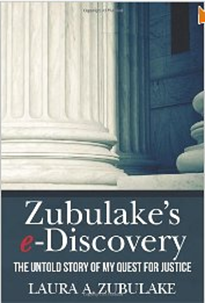
Laura A. Zubulake, the plaintiff in the Zubulake vs. UBS Warburg case, has written a new book: Zubulake's e-Discovery: The Untold Story of my Quest for Justice.  It is the story of the Zubulake case – which resulted in one of the largest jury awards in the US for a single plaintiff in an employment discrimination case – as told by the author, in her words.  As Zubulake notes in the Preface, the book “is written from the plaintiff’s perspective – my perspective. I am a businessperson, not an attorney. The version of events and opinions expressed are portrayed by me from facts and circumstances as I perceived them.”  It’s a “classic David versus Goliath story” describing her multi-year struggle against her former employer – a multi-national financial giant.

Zubulake begins the story by developing an understanding of the Wall Street setting of her employer within which she worked for over twenty years and the growing importance of email in communications within that work environment.  It continues through a timeline of the allegations and the evidence that supported those allegations leading up to her filing of a discrimination claim with the Equal Employment Opportunity Commission (EEOC) and her subsequent dismissal from the firm.  This Allegations & Evidence chapter is particularly enlightening to those who may be familiar with the landmark opinions but not the underlying evidence and how that evidence to prove her case came together through the various productions (including the court-ordered productions from backup tapes).  The story continues through the filing of the case and the beginning of the discovery process and proceeds through the events leading up to each of the landmark opinions (with a separate chapter devoted each to Zubulake I, III, IV and V), then subsequently through trial, the jury verdict and the final resolution of the case.

Throughout the book, Zubulake relays her experiences, successes, mistakes, thought processes and feelings during the events and the difficulties and isolation of being an individual plaintiff in a three-year litigation process.  She also weighs in on the significance of each of the opinions, including one ruling by Judge Shira Scheindlin that may not have had as much impact on the outcome as you might think.  For those familiar with the opinions, the book provides the “backstory” that puts the opinions into perspective; for those not familiar with them, it’s a comprehensive account of an individual who fought for her rights against a large corporation and won.  Everybody loves a good “David versus Goliath story”, right?

The book is available at Amazon and also at CreateSpace.  Look for my interview with Laura regarding the book in this blog next week.

So, what do you think?  Are you familiar with the Zubulake opinions?  Have you read the book?  Please share any comments you might have or if you’d like to know more about a particular topic.

Disclaimer: The views represented herein are exclusively the views of the author, and do not necessarily represent the views held by CloudNine Discovery. eDiscoveryDaily is made available by CloudNine Discovery solely for educational purposes to provide general information about general eDiscovery principles and not to provide specific legal advice applicable to any particular circumstance. eDiscoveryDaily should not be used as a substitute for competent legal advice from a lawyer you have retained and who has agreed to represent you.

eDiscovery Case Law: On the Eve of Trial with Apple, Samsung is Dealt Adverse Inference Sanction


In Apple Inc. v. Samsung Elecs. Co., Case No.: C 11-1846 LHK (PSG) (N.D. Cal.), California Magistrate Judge Paul S. Grewal stated last week that jurors can presume “adverse inference” from Samsung’s automatically deletion of emails that Apple requested in pre-trial discovery.

Two of the world’s dominant smartphone makers are locked into lawsuits against each other all over the globe as they fiercely compete in the exploding mobile handset market. Both multinationals have brought their best weapons available to the game, with Apple asserting a number of technical and design patents along with trade dress rights. Samsung is, in return, asserting their “FRAND” (“Fair, Reasonable and Non-Discriminatory) patents against Apple. The debate rages online about whether a rectangular slab of glass should be able to be patented and whether Samsung is abusing their FRAND patents.

As for this case, Samsung’s proprietary “mySingle” email system is at the center of this discussion. In this web-based system, which Samsung has argued is in line with Korean law, every two weeks any emails not manually saved will automatically be deleted.  Unfortunately, failure to turn “off” the auto-delete function resulted in spoliation of evidence as potentially responsive emails were deleted after the duty to preserve began.

Judge Grewal had harsh words in his order, noting the trouble Samsung has faced in the past:

“Samsung’s auto-delete email function is no stranger to the federal courts. Over seven years ago, in Mosaid v. Samsung, the District of New Jersey addressed the “rolling basis” by which Samsung email was deleted or otherwise rendered inaccessible. Mosaid also addressed Samsung’s decision not to flip an “off-switch” even after litigation began. After concluding that Samsung’s practices resulted in the destruction of relevant emails, and that “common sense dictates that [Samsung] was more likely to have been threatened by that evidence,” Mosaid affirmed the imposition of both an adverse inference and monetary sanctions.

Rather than building itself an off-switch—and using it—in future litigation such as this one, Samsung appears to have adopted the alternative approach of “mend it don’t end it.” As explained below, however, Samsung’s mend, especially during the critical seven months after a reasonable party in the same circumstances would have reasonably foreseen this suit, fell short of what it needed to do”.

The trial starts today and while no one yet knows how the jury will rule, Judge Grewal’s instructions to the jury regarding the adverse inference certainly won’t help Samsung’s case:

“Samsung has failed to prevent the destruction of relevant evidence for Apple’s use in this litigation. This is known as the “spoliation of evidence.

I instruct you, as a matter of law, that Samsung failed to preserve evidence after its duty to preserve arose. This failure resulted from its failure to perform its discovery obligations.

You also may presume that Apple has met its burden of proving the following two elements by a preponderance of the evidence: first, that relevant evidence was destroyed after the duty to preserve arose. Evidence is relevant if it would have clarified a fact at issue in the trial and otherwise would naturally have been introduced into evidence; and second, the lost evidence was favorable to Apple.

Whether this finding is important to you in reaching a verdict in this case is for you to decide. You may choose to find it determinative, somewhat determinative, or not at all determinative in reaching your verdict.”

Here are some other cases with adverse inference sanctions previously covered by the blog, including this one, this one, this one and this one

So, what do you think?  Will the “adverse inference” order decide this case?  Please share any comments you might have or if you’d like to know more about a particular topic.

Disclaimer: The views represented herein are exclusively the views of the author, and do not necessarily represent the views held by CloudNine Discovery. eDiscoveryDaily is made available by CloudNine Discovery solely for educational purposes to provide general information about general eDiscovery principles and not to provide specific legal advice applicable to any particular circumstance. eDiscoveryDaily should not be used as a substitute for competent legal advice from a lawyer you have retained and who has agreed to represent you.