Outsourcing

According to Gartner, Cloud eDiscovery Solutions Gaining Momentum: eDiscovery Trends

According to a new guide by Gartner designed to help General Counsel and IT leaders at organizations evaluate and select eDiscovery solutions for investigative and legal matters, cloud-based eDiscovery solutions are gaining momentum in the market.

Written by Gartner’s industry analyst Jie Zhang, Market Guide for E-Discovery Solutions (available for purchase here) identifies several key findings, including the observation that Software-as-a-Service (SaaS) solutions are gaining momentum, interest in Microsoft’s eDiscovery capabilities continues to build and (not surprisingly) the eDiscovery service market continues to see high merger and acquisition activities.  Ease of use and more competitive and straightforward pricing structures are cited as reasons for the emergence of SaaS solutions in the eDiscovery market.

The Table of Contents for the 24 page guide is as follows:

  • Market Definition
    • Technology
    • Services
  • Market Direction
    • Three Types of Solution Providers
    • Pricing
    • Market Adoption and Growth
  • Market Analysis
    • SaaS Solutions Are Gaining Momentum
    • Building Interest in Microsoft’s E-Discovery Capabilities
    • Searching Across Multiple and Hybrid Data Repositories Becomes More Onerous and Leads to Overinvestment
    • Merger and Acquisition Is Second Nature to the E-Discovery Service Market
    • The Application of Machine-Learning Technology in E-Discovery Beyond the U.S. Market
  • Representative Vendors
    • Representative E-Discovery Solution Providers
  • Market Recommendations
  • Gartner Recommended Reading

According to Rob Robinson’s Complex Discovery site (link here), the report also highlights 50 total providers in the industry (30 software providers, 20 service providers), including CloudNine (shameless plug warning!).  For software providers, deployment model and key technology capabilities or other noteworthy characteristics are identified, for service providers, the report identifies proprietary and/or third party software offered, as well as services offered.  The report concludes with recommendations for general counsel, chief compliance officers, chief information officers (CIOs) and their teams to consider when choosing and implementing eDiscovery solutions, as well as other Gartner recommended reading reports.

The report provides a current list of available software and service providers, with some useful industry observations and recommendations to help organizations in selecting the right provider for them.

So, what do you think?  Are you surprised by any of Gartner’s industry observations?  Please share any comments you might have or if you’d like to know more about a particular topic.

Disclaimer: The views represented herein are exclusively the views of the author, and do not necessarily represent the views held by CloudNine. eDiscovery Daily is made available by CloudNine solely for educational purposes to provide general information about general eDiscovery principles and not to provide specific legal advice applicable to any particular circumstance. eDiscovery Daily should not be used as a substitute for competent legal advice from a lawyer you have retained and who has agreed to represent you.

Is a Blended Document Review Rate of $466 Per Hour Excessive?: Best of eDiscovery Daily

Even those of us at eDiscovery Daily have to take an occasional vacation (which, as you can see by the picture above, means taking the kids to their favorite water park); however, instead of “going dark” for a few days, we thought we would take a look back at some topics that we’ve covered in the past.  Today’s post is our all-time most viewed post ever.  I guess it struck a nerve with our readers!  Enjoy!

______________________________

Remember when we raised the question as to whether it is time to ditch the per hour model for document review?  One of the cases we highlighted for perceived overbilling was ruled upon here.

In the case In re Citigroup Inc. Securities Litigation, No. 09 MD 2070 (SHS), 07 Civ. 9901 (SHS) (S.D.N.Y. Aug. 1, 2013), New York District Judge Sidney H. Stein rejected as unreasonable the plaintiffs’ lead counsel’s proffered blended rate of more than $400 for contract attorneys—more than the blended rate charged for associate attorneys—most of whom were tasked with routine document review work.

In this securities fraud matter, a class of plaintiffs claimed Citigroup understated the risks of assets backed by subprime mortgages. After the parties settled the matter for $590 million, Judge Stein had to evaluate whether the settlement was “fair, reasonable, and adequate and what a reasonable fee for plaintiffs’ attorneys should be.” The court issued a preliminary approval of the settlement and certified the class. In his opinion, Judge Stein considered the plaintiffs’ motion for final approval of the settlement and allocation and the plaintiffs’ lead counsel’s motion for attorneys’ fees and costs of $97.5 million. After approving the settlement and allocation, Judge Stein decided that the plaintiffs’ counsel was entitled to a fee award and reimbursement of expenses but in an amount less than the lead counsel proposed.

One shareholder objected to the lead counsel’s billing practices, claiming the contract attorneys’ rates were exorbitant.

Judge Stein carefully scrutinized the contract attorneys’ proposed hourly rates “not only because those rates are overstated, but also because the total proposed lodestar for contract attorneys dwarfs that of the firm associates, counsel, and partners: $28.6 million for contract attorneys compared to a combined $17 million for all other attorneys.” The proposed blended hourly rate was $402 for firm associates and $632 for firm partners. However, the firm asked for contract attorney hourly rates as high as $550 with a blended rate of $466. The plaintiff explained that these “contract attorneys performed the work of, and have the qualifications of, law firm associates and so should be billed at rates commensurate with the rates of associates of similar experience levels.” In response, the complaining shareholder suggested that a more appropriate rate for contract attorneys would be significantly lower: “no reasonable paying client would accept a rate above $100 per hour.” (emphasis added)

Judge Stein rejected the plaintiffs’ argument that the contract attorneys should be billed at rates comparable to firm attorneys, citing authority that “clients generally pay less for the work of contract attorneys than for that of firm associates”:

“There is little excuse in this day and age for delegating document review (particularly primary review or first pass review) to anyone other than extremely low-cost, low-overhead temporary employees (read, contract attorneys)—and there is absolutely no excuse for paying those temporary, low-overhead employees $40 or $50 an hour and then marking up their pay ten times for billing purposes.”

Furthermore, “[o]nly a very few of the scores of contract attorneys here participated in depositions or supervised others’ work, while the vast majority spent their time reviewing documents.” Accordingly, the court decided the appropriate rate would be $200, taking into account the attorneys’ qualifications, work performed, and market rates.

For this and other reasons, the court found the lead counsel’s proposed lodestar “significantly overstated” and made a number of reductions. The reductions included the following amounts:

  • $7.5 million for document review by contract attorneys that happened after the parties agreed to settle; 20 of the contract attorneys were hired on or about the day of the settlement.
  • $12 million for reducing the blended hourly rate of contract attorneys from $466 to $200 for 45,300 hours, particularly where the bills reflected that these attorneys performed document review—not higher-level work—all day.
  • 10% off the “remaining balance to account for waste and inefficiency which, the Court concludes, a reasonable hypothetical client would not accept.”

As a result, the court awarded a reduced amount of $70.8 million in attorneys’ fees, or 12% of the $590 million common fund.

So, what do you think?  Was the requested amount excessive?   Please share any comments you might have or if you’d like to know more about a particular topic.

Disclaimer: The views represented herein are exclusively the views of the author, and do not necessarily represent the views held by CloudNine. eDiscovery Daily is made available by CloudNine solely for educational purposes to provide general information about general eDiscovery principles and not to provide specific legal advice applicable to any particular circumstance. eDiscovery Daily should not be used as a substitute for competent legal advice from a lawyer you have retained and who has agreed to represent you.

The Cloud is a “Rush” Project’s Best Friend: eDiscovery Best Practices

Today is Friday.  While many of you can look forward to a long, enjoyable Memorial Day weekend, chances are that at least a few of you will be making weekend plans when, late in the day, you will receive a CD, DVD, hard drive or link to data on a server somewhere that needs to be reviewed over the weekend.  There goes your weekend!

Not only that, good luck connecting with your in-house litigation support person or a vendor for assistance late on a Friday – you may play a game of “phone tag” or wait for email responses for a bit.  Lit support people and vendors have weekend plans too.  Even if you do get in touch with them, you then have to fill out a form and arrange to get the data to them, which can be tricky.  It’s a lot of time, hassle and cost to get started – especially if you’re at a small law firm that doesn’t already have an eDiscovery software application to support processing and review of the data.

When consumers quickly need to find that special item to buy, or that new cool song to download, or need to stream the new season of Bloodline (available starting today on Netflix) for binge watching, they turn to the cloud.  More than ever, attorneys are turning to the cloud as well to help them get their “rush” project started immediately.  And, you don’t even have to own the software or interact with anyone to get started.

As an eDiscovery provider that offers a no-risk free trial, CloudNine (shameless plug warning!) sees at least one or two clients a week that give our software a try (many of them with “rush” projects just like this).  The trend toward automation and the cloud in the industry has not only made eDiscovery more affordable than ever, it has also made it easier than ever to get a “rush” project off and running.

If you find yourself in that situation later today, here are three easy steps to get started:

  1. Sign up for a free account here. You will receive an email with your credentials (including temporary password), to get started.
  2. When you first log in, you’ll see a button to “Upload Data”. That will take you to a form to download the CloudNine Discovery client (which is a Windows based client application that resides on your desktop) for uploading data for processing.  Download and install the client to upload data.
  3. Once the client is downloaded and installed, launch the client, log in with your newly created credentials and simply follow the wizard prompts to upload the desired data set and put it into the project of your choice (which you can create if it doesn’t already exist). It’s that easy!

We can’t get you out of working this weekend.  But, we can take the hassle out of getting started.  You’re welcome.  :o)

So, what do you think?  Have you been faced with any “rush” eDiscovery projects lately?  Please share any comments you might have or if you’d like to know more about a particular topic.

eDiscovery Daily will return on Tuesday as we remember this Memorial Day the people who gave their lives while serving in our armed forces.

Disclaimer: The views represented herein are exclusively the views of the author, and do not necessarily represent the views held by CloudNine. eDiscovery Daily is made available by CloudNine solely for educational purposes to provide general information about general eDiscovery principles and not to provide specific legal advice applicable to any particular circumstance. eDiscovery Daily should not be used as a substitute for competent legal advice from a lawyer you have retained and who has agreed to represent you.

Your “Mashup” of eDiscovery Market Estimates is Early This Year: eDiscovery Trends

We look forward to the eDiscovery Market Size Mashup that Rob Robinson compiles and presents on his Complex Discovery site each year.  Each of the past three years in July, we have covered his compilations of various eDiscovery market estimates, with estimates for 2012 to 2017, for 2013 to 2018 and 2014-2019 (in two parts).  This year, we don’t have to wait until July: he has released his worldwide eDiscovery software overview for 2015 to 2020 now!

As always, the compilation is “[t]aken from a combination of public market sizing estimations as shared in leading electronic discovery publications, posts and discussions over time”.  Rob’s “Mashup” shares general market sizing estimates for both the software and service areas of the electronic discovery market for the years between 2015 and 2020.

Here are some highlights (based on the estimated from the compiled sources):

  • The eDiscovery Software and Services market is expected to grow an estimated 13.15% Compound Annual Growth Rate (CAGR) per year from 2015 to 2020 from $7.33 billion to $13.597 billion per year. Services will comprise approximately 71.69% of the market and software will comprise approximately 28.31% by 2020.
  • The eDiscovery Software market is expected to grow an estimated 14.75% annual growth per year from 2015 to 2020 from $1.935 billion to $3.849 billion per year. Software currently comprises 26.39% of the market, which will rise to 28.31% by 2020.  Also by 2020, 70% of the eDiscovery software market is expected to be “off-premise” – which includes cloud-based and other Software-as-a-Service (SaaS)/Platform-as-a-Service (PaaS)/Infrastructure-as-a-Service (IaaS) solutions.
  • The eDiscovery Services market is expected to grow an estimated 12.55% annual growth per year from 2015 to 2020 from $5.397 billion to $9.748 billion per year. The breakdown of the services market by 2020 is expected to be as follows: 68% review, 19% processing and 13% collection (over the past three years, review was at 73% and collection was at 8%).

Growth rates are fairly steady with those reported last year, though down from the estimates the prior two years.

Here are the sources that Rob states were used in compiling the “mashup” (including his own, how clever!):

  • U.S. Department of Commerce, International Trade Administration. 2016 Top Markets Report – Cloud Computing. April 14, 2016.
  • “eDiscovery Business Confidence Survey – Winter 2016 Results.” ComplexDiscovery. March 2, 2016.
  • “Worldwide eDiscovery Services Forecast 2014-2019.” Sean Pike, Angela Gelnaw. December 2015.
  • Gartner, Inc. “Critical Capabilities for E-Discovery Software.” Jie Zhang, Garth Landers. October 6, 2015.
  • Transparency Market Research. “eDiscovery Market – Global Industry Analysis, Size, Share, Growth, Trends and Forecast 2014-2022.” July 6, 2015
  • Markets and Markets. “E-Discovery Market By Solution, Deployment, Industry, & Region – Global Forecast to 2020. July 2015.
  • Global Industry Analysts, Inc. “eDiscovery (Software and Services) Global Strategic Business Report.” May 28, 2015.
  • Gartner, Inc. “Magic Quadrant for E-Discovery Software.” Jie Zhang, Garth Landers. May 18, 2015.
  • The Radicati Group. “eDiscovery Market, 2014-2018.” Sara Radicati. December 3, 2014.
  • Transparency Market Research. “eDiscovery Market – Global Industry Analysis, Size, Share, Growth, Trends and Forecast, 2014-2020).” June 2014.
  • Gartner, Inc. “Magic Quadrant for E-Discovery Software.” Jie Zhang, Debra Logan, Garth Landers. June 19, 2014.
  • “Worldwide eDiscovery Software 2014-2018 Forecast.” Sean Pike. May 2014.
  • The Radicati Group. “eDiscovery Market, 2013-2017.” Sara Radicati. August 2013.
  • Gartner, Inc. “Magic Quadrant for E-Discovery Software.” Debra Logan, Alan Dayley, Sheila Childs. June 10, 2013.
  • The Radicati Group. “eDiscovery Market, 2012-2016.” Sara Radicati, Todd Yamasaki. October 2012.
  • Transparency Market Research. “World e-Discovery Software & Service Market Study.” August 2012.
  • Rand Institute For Civil Justice. “Where the Money Goes: Understanding Litigant Expenditures for Producing Electronic Discovery.” Nicolas Pace and Laura Zakaras. April 2012.
  • “MarketScape: Worldwide Standalone Early Case Assessment Applications Vendor Analysis.” Vivian Tero. September 19, 2011.
  • Industry Observer Estimations (Multiple Observers)

So, what do you think?  Do you think the eDiscovery software market is slowing down?  Or is it simply a matter of the market maturing over time?  Please share any comments you might have or if you’d like to know more about a particular topic.

Disclaimer: The views represented herein are exclusively the views of the author, and do not necessarily represent the views held by CloudNine. eDiscovery Daily is made available by CloudNine solely for educational purposes to provide general information about general eDiscovery principles and not to provide specific legal advice applicable to any particular circumstance. eDiscovery Daily should not be used as a substitute for competent legal advice from a lawyer you have retained and who has agreed to represent you.

Whip Me, Beat Me, Call Me Edna: eDiscovery Trends

If you remember the song from the ‘80s with that title and the group that performed it, then you win the obscure trivia of the day award… :o)

One of the more interesting sessions at this week’s ACEDS conference was the session EDNA Challenge Part 2, where Tania Mabrey, Craig Ball and Tom O’Connor followed up on Craig’s original challenge from seven years ago (discussed in his paper E-Discovery for Everybody: The EDna Challenge) to conduct eDiscovery in a case on a budget of only $1,000.  This time, the challenge was to do so at a cost of $5,000.  While that might seem like an easier challenge, data volumes have risen dramatically, so it may be even more of a challenge than it was back then.

Preceding the session, Craig posted information about his challenge on his blog, Ball in Your Court.  The parameters for the new challenge were as follows:

“Your old friend, Edna, called with a question.  She has a small law firm.  A client is about to send her a Zip file on a thumb drive containing collected ESI in a construction dispute.  It will be PSTs for six people, another four MBOX takeouts from Gmail and a mixed bag of word processed documents, spreadsheets, PowerPoint documents, PDFs and “not a lot” of scanned paper documents (sans OCR or load files) for all ten custodians.  There may also be some video, photographs and web content.  “Nothing too hinky,” she promises.  She thinks it will comprise less than 50,000 documents in all, but it could grow to 100,000 items or more.  The contents will unzip to about 10-12 GB in all.”

Among other things, Craig goes on to tell us that Edna will need a review solution that will support three reviewers, review may take up to 90 days, the case may not conclude for up to two years and Edna is willing to spend up to $5,000 “ALL IN, for software, vendor services, SaaS, whatever, exclusive of the cost of her time and staff time), but she won’t spend a penny more.”  The gauntlet is thrown.

So far, there have been 24 responses to Craig’s blog post (and Craig evidently received additional responses via email).  Some are questions or observations from representatives of eDiscovery providers, others are responses from Craig to those questions and observations (let’s just say if you didn’t take the challenge seriously or tried to change the parameters, Craig’s response was direct, to say the least).

In the session, Craig, Tom and Tania reviewed some of the alternatives that had been provided to him, including one from CloudNine (shameless plug warning!), provided by our CEO, Brad Jenkins.  You can read the breakdown of Brad’s offering in the comments to the blog post (Craig’s classic response was “Thanks for the helpful breakout. Can’t help but hear Samuel L. Jackson’s voice in Pulp Fiction: “Look at the big brains on Brad!””).

As an eDiscovery provider that offers a no-risk free trial, we see at least one or two Edna-like clients a week that give our software a try (and, unlike some software platforms, they get the same features and capabilities as our Fortune 500 clients do).  The trend toward automation and the cloud in the industry have made eDiscovery more affordable than ever for the Ednas of the world and CloudNine is proud to be a part of that trend.  No need to whip or beat Edna any more.

So, what do you think?  Do you think that eDiscovery software is now affordable for all lawyers?  Please share any comments you might have with us or let us know if you’d like to know more about a particular topic.

Disclaimer: The views represented herein are exclusively the views of the author, and do not necessarily represent the views held by CloudNine. eDiscovery Daily is made available by CloudNine solely for educational purposes to provide general information about general eDiscovery principles and not to provide specific legal advice applicable to any particular circumstance. eDiscovery Daily should not be used as a substitute for competent legal advice from a lawyer you have retained and who has agreed to represent you.

Court Denies Request for Cost Reimbursement for Hosted eDiscovery Database: eDiscovery Case Law

In Associated Electric & Gas Insurance Services, et. al. v. BendTec, Inc., No. 14-1602 (D. Minn., Feb. 24, 2016), Minnesota District Judge Michael J. Davis found that the decision in Race Tires America, Inc. v. Hoosier Racing Tire Corp. to deny certain eDiscovery costs to be persuasive and ruled that “the costs of creating and maintaining an electronic platform for e-discovery are not recoverable under § 1920(4)”, denying the prevailing defendant’s request for reimbursement of over $123,000 in costs to maintain their ESI database.

Case Background

The defendant asserted that the plaintiffs produced approximately 19 gigabytes of data from a prior related lawsuit and it retained eDiscovery vendors to create and maintain an electronic platform for these documents (at a cost of $90 per gigabyte per month), so they could be processed and hosted in a viewable format.  The defendant eventually added its additional 192 gigabytes of data in preparation for production to the plaintiffs, which was hosted at the same $90 per gigabyte per month rate.

After the court entered judgment in favor of the defendant in June 2015, the defendant submitted its bill of costs to the Clerk of Court in July 2015 and the plaintiffs filed their objection to the bill of costs in August 2015.  The Clerk of Court entered a Cost Judgment on October 15, 2015 denying the taxation of costs by the defendant on the basis that fees for electronic discovery are not taxable by the Clerk. The defendant subsequently filed a motion for review of cost judgment, seeking to recover $126,970.80 in costs incurred by creating and maintaining an electronic database to hold documents produced by the plaintiffs and collecting and securing its own documents.  Following an objection from the plaintiffs, the defendant reduced the requested amount to $123,260.80.

Judge’s Ruling

Noting that “a number of courts that have addressed whether costs associated with e-discovery are recoverable under § 1092 have found that such costs are recoverable only to the extent they qualify as exemplification fees or the costs of making copies”, Judge Davis cited Race Tires America, Inc. v. Hoosier Racing Tire Corp., indicating that “the district court awarded the prevailing party the costs for e-discovery on the basis that it ‘appeared to be the electronic equivalent of exemplification and copying.’”  However, Judge Davis indicated that, on appeal, “the Third Circuit held that where e-discovery did not produce illustrative evidence or the authentication of public records, the costs for such discovery did not qualify as exemplification fees under § 1920(4) and is not recoverable” (we covered both rulings here and here).  Judge Davis specifically noted that “[a]s to costs associated with the collection and preservation of electronically stored information (“ESI”), processing and indexing ESI, and keyword searching of ESI for responsive and privileged documents, the court held that such costs are not recoverable under §1920(4).”

Indicating that other courts had found the Race Tires decision persuasive, Judge Davis stated that he “also finds the Race Tire decision persuasive and holds that the costs of creating and maintaining an electronic platform for e-discovery are not recoverable under § 1920(4)” and denied the defendant’s motion for recovery of those costs.

So, what do you think?  Is § 1920(4) still timely for consideration of cost reimbursement to prevailing parties?  Or should it be revisited and updated to reflect the current technological environment?  Please share any comments you might have or if you’d like to know more about a particular topic.

Disclaimer: The views represented herein are exclusively the views of the author, and do not necessarily represent the views held by CloudNine. eDiscovery Daily is made available by CloudNine solely for educational purposes to provide general information about general eDiscovery principles and not to provide specific legal advice applicable to any particular circumstance. eDiscovery Daily should not be used as a substitute for competent legal advice from a lawyer you have retained and who has agreed to represent you.

Here are Some Questions to Ask When Selecting an eDiscovery Vendor: eDiscovery Best Practices

Let’s face it, there are a lot of eDiscovery vendors out there – like CloudNine (shameless plug warning!).  But, how do you find out which vendor is right for you?  Ask a lot of questions, of course!  Here is an article that provides several good ones to ask.

This article in the Florida Bar Practice Resource Institute (PRI) Blog ( Questions You Should Ask When Selecting An E-Discovery Vendor , written by David R. Hazouri, Esq.) covers questions that 1) are aimed at getting a sense for the vendor’s market position, business philosophy and long term stability, 2) attempt to drill down on the technical components of the vendor’s operations, and 3) seek to probe how the vendor proposes to handle your matter as you have generically described it.  Let’s take a look at each section of questions more closely.

Market Position, Business Philosophy and Long Term Stability

Several good questions here, ranging from some obvious ones (How long has the company been working in e-discovery?) to not-so-obvious (What is the vendor’s philosophy/business practices with respect to technology: have they developed solutions in-house or are they tech-agnostic?).  Here are a couple in particular worth noting:

  • How does the vendor distinguish itself from its competitors and who does the vendor think it compete with? Obvious questions, but I’m amazed how many prospective clients don’t ask us those questions.  If the eDiscovery vendor can’t concisely identify three to five points of differentiation from its competitors, how are you really going to know that they’re the right vendor for you?
  • What is the vendor’s philosophy with respect to management and personnel? The author goes on to ask several questions, such as “are the founders still present” and “are there any experienced attorneys in key positions”.  In addition to his questions, I would want to know average tenure at the company for employees in general and number of years of experience in litigation support and eDiscovery – you want a vendor that isn’t experiencing a lot of turnover with key personnel that have seen a little bit of everything in the industry.

Technical Components of the Vendor’s Operations

Here are a couple of notable questions in this section:

  • What does the vendor do to maintain the security and integrity of client data? In addition to what the author covers, I would want to know about the vendor’s policies regarding chain of custody and, if they are a hosting provider, more information about where your data is stored, including the list of security mechanisms the vendor provides and whether the data is stored in some sort of protected data center or in the public cloud.  With one, you know where your data is located, in the other, you may not.
  • With respect to review platform technology in particular, are there any compatibility issues between the vendor’s processes and either your firm’s platform or any popular platform that the opposing party may be using? The more software that has to be installed, the more potential issues may occur, so browser and platform independence is a plus when you want a smooth implementation.

Handling of Your Matter

This section gets into the breadth and scalability of services provided by the vendor and has the most questions.  The author covers services ranging from custodian interviews to forensic data collection to Early Case Assessment to logical document determination for scanned files without document breaks, as well as hosting pricing and production capabilities.  Very often, you may have a need for services that you didn’t anticipate up front, so it’s important to get a thorough understanding of how the vendor provides those additional services in case you need them.  And, it’s important that their pricing structure is straightforward so that you can predict your eDiscovery costs with reasonable accuracy up front.

I love question list articles like this because each one usually has a little bit different take and identifies at least a couple of unique questions to help select the right provider.  As I see other articles and blog posts out there with good questions for eDiscovery providers, I’ll try to share them as well.

So, what do you think?  Do you have any other questions that you ask to select an eDiscovery provider?  Please share any comments you might have with us or let us know if you’d like to know more about a particular topic.

Disclaimer: The views represented herein are exclusively the views of the author, and do not necessarily represent the views held by CloudNine. eDiscovery Daily is made available by CloudNine solely for educational purposes to provide general information about general eDiscovery principles and not to provide specific legal advice applicable to any particular circumstance. eDiscovery Daily should not be used as a substitute for competent legal advice from a lawyer you have retained and who has agreed to represent you.

Ralph Losey of Jackson Lewis, LLP: eDiscovery Trends

This is the eighth and final of the 2016 LegalTech New York (LTNY) Thought Leader Interview series.  eDiscovery Daily interviewed several thought leaders at LTNY this year to get their observations regarding trends at the show and generally within the eDiscovery industry.  Unlike previous years, some of the questions posed to each thought leader were tailored to their position in the industry, so we have dispensed with the standard questions we normally ask all thought leaders.


Today’s thought leader is Ralph Losey. Ralph is an attorney in private practice with the law firm of Jackson Lewis, LLP, where he is a Shareholder and the firm’s National e-Discovery Counsel. Ralph is also a prolific author of eDiscovery books and articles, the principal author and publisher of the popular e-Discovery Team® Blog, founder and owner of an online training program, e-Discovery Team Training, with attorney and technical students all over the world, founder of the new Electronic Discovery Best Practices (EDBP) lawyer-centric work flow model. Ralph is also the publisher of LegalSearchScience.com and PreSuit.com on predictive coding methods and applications.

What are your general observations about LTNY this year and about eDiscovery trends in general?

{Interviewed the second day of LTNY}

I have not been on the vendor floor yet, but I hope to get there.  I have been in several meetings and I was able to attend the keynote on cybersecurity today by Eric O’Neill, who was a terrific speaker.  They started out by showing the movie that was made of the big event in his life where they caught the biggest spy America has ever had.  He talked about that incident and cybersecurity and it was very good.  Of course, cybersecurity is something that I’m very interested in, but not so much as an expert in the field, but just as an observer.  My interest in cybersecurity is only as it relates to eDiscovery.  O’Neill was talking about the big picture of catching spies and industrial espionage and the Chinese stealing American secrets.  It was very good and the auditorium was filled.

Otherwise, the show seems quite alive and vibrant, with orange people and Star Wars characters here and there as a couple of examples of what the providers were doing to get attention here at the show.  I have been live “tweeting” during the show.  Of course, I’ve seen old friends pretty much everywhere I walk and everybody is here as usual.  LTNY remains the premier event.

One trend that I’ll comment on is the new rules.  I didn’t think the rules would make that much difference.  Maybe they would be somewhat helpful.  But, what I’m seeing in practice is that they’ve been very helpful.  They really seem to help lawyers to “get it”.  Proportionality is not a new message for me, but having it in the rules, I have found more helpful than I thought.  So far, so good, knock on wood – that has been a pleasant surprise.  I’m upbeat about that and the whole notion of proportionality, which we’ve really needed.  I’ve been talking about proportionality for at least five years and, finally, it really seems to have caught on now, particularly with having the rules, so I’m upbeat about that.

I’ve observed that there seems to be a drop off in sessions this year discussing predictive coding and technology assisted review (TAR).  Do you agree and, if so, why do you think that is?

I read that too, but it seems like I’ve seen several sessions that are discussing TAR.  I’ve noticed at least four, maybe five sessions that are covering it.  I noticed that FTI was sponsoring sessions related to TAR and Kroll was as well.  So, I’m not sure that I agree with that 100%.  I think that the industry’s near obsession with it in some of the prior shows is maybe not a fair benchmark in terms of how much attention it is getting.  Since it’s my area of special expertise, I would probably always want to see it get more attention, but I realize that there are a number of other concerns.  One possible reason for less coverage, if that is the case, is that TAR is less controversial than it once was.  Judges have all accepted it – nobody has said “no, it’s too risky”.  So, I think a lot of the initial “newsworthiness” of it is gone.

As I stated in my talk today, the reality is that the use of TAR requires training via the old fashioned legal apprenticeship tradition.  I teach people how to do it by their shadowing me, just like when I first learned how to try a case when I carried the briefcase of the trial lawyer.  And, after a while, somebody carried my briefcase.  Predictive coding is the same way.  People are carrying my briefcase now and learning how to do it, and pretty soon, they’ll do it on their own.  It only takes a couple of matters watching how I do it for somebody to pick it up.  After that, they might contact me if they run into something unusual and troublesome.  Otherwise, I think it’s just getting a lot simpler – the software is getting better and it’s easier to do.  You don’t need to be a rocket scientist.

My big thing is to expose the misuse of the secret control set that was making it way too complicated.  No one has stood up in defense of the secret control set, so I think I’m succeeding in getting rid of one of the last obstacles to adopting predictive coding – this nonsense about reviewing and coding 10,000 random documents before you even start looking for the evidence.  That was crazy.  I’ve shown, and others have too, that it’s just not necessary.  It overcomplicates matters and, if anything, it allows for a greater potential for error, not less as was its intent.  We’ve cleaned up predictive coding, gotten rid of some mistaken approaches, the software is getting better and people are getting more knowledgeable, so there’s just no longer the need to have every other session be about predictive coding.

One trend that I’ve observed is an increased focus on automation and considerable growth of, and investment in, eDiscovery automation providers.  What are your thoughts about that trend?

It is the trend and it will be the trend for the next 20 or 30 years.  We’re just seeing the very beginning of it.  The first way it has impacted the legal profession is through document review and the things that I’m doing.  I love artificial intelligence because I need the help of artificial intelligence to boost my own limited intelligence.  I can only remember so many things at once, I make mistakes, I’m only human.  So, I believe that AI is going to augment the lawyers that are able to use it and they are going to be able to do much, much more than before.  I can do the work of one hundred linear reviewers with no problem, by using a software AI enhancement.

It’s not going to put lawyers out of work, but it is going to reduce the volume of menial tasks in the law.  For mental tasks that a lawyer can do that require just simple logic, a computer can do those tasks better than a human can do them.  Simple rules-based applications, reviewing documents – there are many things that lawyers do that a computer can do better.  But, there are also many, many things that only a human can do.  We’re nowhere near actually replacing lawyers and I don’t think we ever will.

Just like all of the great technology doesn’t replace doctors in the medical profession – it just makes them better, makes them able to do miraculous things.  The same thing will happen in the law.  There will be lawyers, but they will be able to do what, by today’s standards, would look miraculous.  How did that lawyer know how that judge was going to rule so exactly?  That’s one of the areas we’re getting into with AI – predicting not just the coding of documents, but predicting how judges will rule.  Right now, that’s an art form, but that’s the next big step in big data.  They are already starting to do that in the patent world where they already have a pretty good idea how certain judges will rule on certain things.  So, that’s the next application of AI that is coming down the road.

I think the continued advancement of AI and automation will be good for lawyers who adapt.  For the lawyers that get technology and spend the time to learn it, the future looks good.  For those who don’t and want to keep holding on to the “buggy whip”, they will find that the cars pass them by.

It seems like acquisition and investment in the eDiscovery market is accelerating, with several acquisitions and VC investments in providers in just the past few months.  Do you feel that we are beginning to see true consolidation in the market?

Yes, I think it’s more than just beginning – I think it’s well underway.  And, I think that’s a good thing.  Why?  Because there are so many operations that are not solid, that, in a more sophisticated market, wouldn’t survive.  But, because many legal markets around the country are not sophisticated about eDiscovery, they are able to sell services to people who just don’t know any better and I don’t think these people are helping the legal profession.  So, consolidation is good.  I’m not saying that “new blood” isn’t good too, if those providers are really good at what they do.  But, I think that’s a natural result of the marketplace itself becoming more sophisticated.

However, I do think the entire industry is vulnerable someday to extreme consolidation if Google and IBM decide to take an interest in it.  I’ve long predicted that, at the end of the day, there will be three or four players.  Aside from Google and IBM, who that will be, I don’t know.  Maybe Google and IBM will never go into it.  But, I believe Google will go into it and I think IBM will do so too.  While I don’t have any inside knowledge to that effect, I think they’re probably researching it.  I think they would be silly not to research it, but I don’t think they have a big staff devoted to it.

I read about this a lot because I’m curious about IBM in particular and I think that IBM is focusing all of its resources right now on medicine and doctors.  They do have a booth here and they do have some eDiscovery focus, particularly on preservation and the left side of the EDRM model.  What they don’t have yet is “Watson, the review lawyer”.  In fact, I have said this in my Twitter account that if there ever is a “Watson, the review lawyer”, I challenge him.  They can beat Jeopardy, but when it comes to things as sophisticated as legal analysis, I don’t think they’re there yet. Several of our existing e-Discovery vendor software is better. Anybody could beat a regular human, but when it comes to beating an “automated human”, I don’t think IBM is there yet. I bet IBM will have to buy out another e-discovery vendor to enhance their Watson algorithms.  I hope I’m still practicing when they are ready, because I’d like to take them on.  Maybe I’ll get beaten, but it would be fun to try and I think I can win, unless they happen to buy the vendor I use. Regardless, I think it’s clear that technology is going to keep getting better and better, but so will the tech savvy lawyers who use the technology to augment their human abilities of search and legal analysis. The key is the combination of Man and Machine, which is what I call the “hybrid” approach.

What are you working on that you’d like our readers to know about?

I am looking into the feasibility of having an eDiscovery “hackathon”.  If you’ve heard of a regular “hackathon”, you get the idea.  This would be a 24 hour event where the technology providers who think they are the best in document review come together and compete.  It would be a fair and open content, run by scientists, where everybody has the same chance.  Scientists will compute the scores and determine who obtained the best recall and best precision to determine a winner.  It would be a way for us to generate interest the same way that cybersecurity does, using a live event to allow people to watch how high-tech lawyers do it.  I think you would be amazed how much information can be found in 24 hours, if you’re using the technology right.  It will be a proving ground for those vendors who think they have good software.  Basically, I’m saying “show me”, “put up or shut up”.

The reality is, my presentation today was on TREC and I showed up with Kroll Ontrack – the only other vendor to show up was Catalyst, nobody else showed up.  So, I’m going to make it easier and say “it’s 24 hours, compete!”  Anybody can say that they’re great, but show me – I want to see it to believe it.  Everybody loves competition – it’s fun.  My concern is all the other vendors will be too risk adverse to compete against us. They are just empty suits.

For me, it’s exciting to do document review.  I enjoy document review and if you don’t enjoy document review, you’re doing something wrong.  You’re not really harnessing the power of artificial intelligence.  Because working with a robot at your side that’s helping you find evidence can be a lot of fun.  It’s somewhat like an Easter egg hunt – it’s fun to look for things when you have the help of AI to do the heavy lifting for you.   Review a million documents?  No problem if you have a good AI robot at your side.

So, I’m thinking of ways to show the world what eDiscovery can do and, within our community, to see who are among us is really the best.  I have won before, so I think I can do it again, but you never know. There are many other great search attorneys out there. If we do pull it off with a hackathon, or something like that, there may not be one clear winner, but there may be a few that do better than others. It’s never been done before and I like to do things that have never been done before. But it will not happen unless other vendors step up to the plate and have the confidence to dare to compete. Time will tell…

Thanks, Ralph, for participating in the interview!

And to the readers, as always, please share any comments you might have or if you’d like to know more about a particular topic!

Disclaimer: The views represented herein are exclusively the views of the author, and do not necessarily represent the views held by CloudNine. eDiscovery Daily is made available by CloudNine solely for educational purposes to provide general information about general eDiscovery principles and not to provide specific legal advice applicable to any particular circumstance. eDiscoveryDaily should not be used as a substitute for competent legal advice from a lawyer you have retained and who has agreed to represent you.

Pete Feinberg of Consilio: eDiscovery Trends

This is the seventh of the 2016 LegalTech New York (LTNY) Thought Leader Interview series.  eDiscovery Daily interviewed several thought leaders at LTNY this year to get their observations regarding trends at the show and generally within the eDiscovery industry.  Unlike previous years, some of the questions posed to each thought leader were tailored to their position in the industry, so we have dispensed with the standard questions we normally ask all thought leaders.

Today’s thought leader is Pete Feinberg.  Pete is Senior Vice President of Product Strategy at Consilio, responsible for the overall product strategy and product management of Consilio’s products and services line.  Prior to joining Consilio, Pete ran marketing for the largest vertical of Blackboard – a Washington DC-based education technology company. Prior to that, Pete served as vice president in various product, partner marketing and eCommerce roles at a variety of B2B software and B2C eRetail companies in the Washington DC area. Pete’s specialties are in guiding product strategy, bringing new products and services to market, representing the voice of the client as an executive “client advocate”, and guiding the service delivery organization to engage with clients not as a vendor, but instead as a trusted advisor.

What are your general observations about LTNY this year?

For me, LTNY has always been about connecting with clients and prospective clients.  As we do so, we hearing about the challenges that people are having, and what they’re doing to tackle those challenges, and what we ought to be doing as a services provider to help them overcome those challenges.  In that regard, I think it has been a great LegalTech.

From my vantage point, it makes an awful lot of sense for those in the legal community to come in every two years to stay connected, understand the state of the technology in our industry, talk with people that you haven’t seen in a while and be a part of the innovation and evolution of our space.  From that perspective, it has been a very fulfilling LegalTech and I’ve had a lot of fun doing so.

At the end of the day, LegalTech or anything else we do is about connecting with our clients.  It’s about making sure that we have the opportunity to have that discussion.  If that discussion can happen in a large format, splashy booth – so be it.  If it can happen in other venues that are less expensive, that’s even better.  What’s important to us – and guides all that we do here at LTNY – is making sure that we have that discussion with our clients one way or another.  We’ll continue to recalibrate and figure out our best approach to LTNY as we go.

It seems like acquisition and investment in the eDiscovery market is accelerating, with Consilio being forefront in that acquisition and investment in the market.  Do you feel that we are beginning to see true consolidation in the market?

Our industry is reaching a plateau of maturity.  My history in the eDiscovery and legal space goes back three years, so I’ll echo what I’ve heard from those who’ve been in the space before I got here.  Those long-timers tell the story that there was a time when LegalTech was not always all about eDiscovery.  But right now, when you look around, it’s almost an eDiscovery event and other technology is more of a footnote.  That may be overstating it a bit, but let’s just say that eDiscovery providers are taking a dominant position in all of the major signage around the show and, if you look at all of the major booths on the exhibit floor, they all seem to be eDiscovery-oriented.

In the past couple of years, the common theme people were echoing was a sentiment of disappointment or feeling of loss that there was no new “next big thing”.  That’s a bit of a head scratcher personally, because technology will proceed at technology’s pace and it seems that statement is somewhat grounded in expectation that technology is always going to come up with some discontinuous innovation in a 12 month cycle that’s going to turn the entire market on its head and that’s just not a reasonable expectation as markets mature over time.

I also believe the activity that we’re seeing on the consolidation and M&A front is very indicative of the market maturing.  Niches have largely been filled.  And US-centric service providers have increased their depth, either organically or through inorganic acquisition.  But there is still a bit of a “wild west” openness outside of the US.  In Europe, there are fewer true providers and in Asia, there are fewer true providers still.  So, there is still opportunity for investment, innovation and growth, and I expect that’s going to continue to create attractive M&A targets.

But, I think the consolidation wave that preceded this Legaltech is evidence of market maturation.  There will always be innovation, even today, even in this LegalTech, you still see folks that are coming up with interesting ways to spin technologies with existing underlying engines.  Now it may not be “discontinuous, next big thing innovation”, but there is a constant, steady stream of innovation all around us exemplified by providers at this very show.  For example, analytics engines have been around for a while, half-a-dozen years even, but now you see them presented and integrated into meaningful workflows that are pragmatically useful to attorneys – better than in the past.    So, I think you’ll continue to see refinement of technology and refinement of workflows and a focus on meaningful, useful exposure of those technologies to attorneys.   So the market should expect that providers will continue to do interesting things, but those things may not be considered big and splashy and “next big” level of innovation.

Going back to your question in terms of consolidation, as markets mature, it’s naturally going to happen.  Investors, at some point in time, will want to realize return and that often happens through a sale.  I also think that there are some macro trends in the market that are fueling this trend.   In fact, there is actually an article in LegalTech News (the printed magazine) called Shark Bait by Zach Warren that is very much about this topic.

We’re continuing see evolution of eDiscovery into a true global industry.  Multinationals have global operations, they have data stores around the world in disparate systems, that originated from within smaller acquired companies.  So there are these pockets of data that the global entity really is unfamiliar with.  Then when matter sparks, the legal team – who is the least aware of these data stores – have to get their data from data stores in Serbia or Singapore.  If those legal teams have a mid-market eDiscovery services provider that is US-centric, well, that poses challenges.  We are seeing more cross-border matters, and more data collected from data stores outside the US – and as that trend continues, that will fuel the need for service providers that can support that global reach.

At Consilio, we made that leap to being a truly global eDiscovery services provider earlier than most folks did.  We were doing this back in 2006 and 2007.  We made our own missteps as you would expect of all companies doing so, but we persevered and became a truly global (in fact, by some measures more global than domestic) eDiscovery provider.  That made us very attractive for investment.  It’s one of the reasons that Shamrock Capital invested in Consilio and it’s a similar situation to what is fueling some of these eDiscovery acquisitions happening today.  Multinationals need global reach and they also need depth of bench – they need both.  Those providers that have both will be successful.

One trend that I’ve observed is an increased focus on automation and considerable growth of, and investment in, eDiscovery automation providers.  What are your thoughts about that trend?

We have to think about the eDiscovery technology market in subsectors or subcomponents.  Consider that eDiscovery is a very different game for a 175 custodian, six year collection out of systems that originate in Japan or Belgium than it is for a mid-sized law firm that generally focuses on employment law with one or two local custodians over a six month period.  These are very different things.

Those who aren’t serial litigants, and are focusing on more small-scale matters don’t always necessarily want to put those matters into Relativity.  They don’t want to have to go through an elongated processing step.  They just have a PST from somebody in the organization and they just want to look at those documents and apply a couple of tags.  So, on the one hand, you’re seeing automation from folks like Everlaw or CloudNine that allow for the “automation” of just dragging a PST folder into a web app and the files unpack automatically and the metadata is created, with simple point-click-go tagging.  That need exists and I think there’s a model now (and I’ve heard it a couple of times this week alone) where attorneys have said “I like self-service”.  Up to a point.  In cases where that’s a preferred flow leveraging automation, the attorney may have a need to graduate to Relativity or some other more mature platform with project managers who will provide value and guidance and best practices – but there is a cost to that.

I believe that there is a long-term trend in the market toward self-service.  That means that providers must and will continue to refine their user experiences and software in a way they were not three to five years ago.  I think it’s a responsibility of technology creators and innovators to meet the market where it is and to bring it forward and I think automation is a big, big part of that.

Let me also add that even at the large-scale end of the market, typically with companies that are used to a routine frequency of matters, there is a need for automation.  Along these lines, one of our strategic clients stopped me during our discussion about technology and said “tell me about automation in your platform”.  This is a client that has total eDiscovery spend well north of $100 million per year.  And, even in that scenario, she was interested in automation.  The reason is that these large scale investigations get very complex.  One of our most complex matters, we actually have over 3,200 discrete assignment batches within a single security group in a project that, itself, has five different security groups.  When you have 3,200 assignments, how do you keep track of all that?  Well that needs to be visualized, and the workflow needs to be automated – especially when you have project managers that are billing north of $100 US per hour who would otherwise be performing these tasks.  These clients need self-service for the large-scale matters just like clients do for the smaller-scale matters.  So there’s a drive toward automation at all levels of the spectrum.

What are you working on that you’d like our readers to know about?

Our story is pretty simple at LegalTech this year.  We’ve brought together not just two companies, but three companies, with the inclusion of Proven Legal Technologies – a well respected eDisclosure services and litigation support company in the UK.  We’ve brought together these fantastically experienced pieces, but we’ve done so in a way that’s so complementary.  I’m not sure that I’ve ever seen its equal in my years, not only in this industry, but in other industries where I’ve worked.

If you asked Huron Legal before the acquisition who their target client is, they would say it’s the Fortune 2000 multinational corporation with global operations with some sort of investment already made in their own in-house eDiscovery capabilities.  From Consilio, you would have heard pretty much the same answer.  You would also have heard the same answer on the law firm side – that we tend to partner with AmLaw 200 law firms that have some level of global operations and tend to get involved in global investigations and large-scale litigation.  On the surface, you would probably say that these two organizations probably have a tremendous amount of overlap.  But, now that we’ve put the pieces on the table side-by-side, it’s phenomenal how tremendously complementary they are and how they don’t overlap.  When you look on a client basis, there are a very small handful of our clients that are actually shared and even those that are shared tend to be law firms with a different practice area, so even those aren’t completely shared.  Less than five percent of our total client base actually overlapped, which is phenomenal.

When you look at capabilities where Huron Legal was incredibly strong – Relativity hosting, Nuix processing, Brainspace analytics and an incredible depth of bench here in the US, but not outside of the US – it married perfectly with Consilio’s tremendous global capability that dates back to 2006 where we made investments in APAC and Europe.  So, there was also a tremendous complementary nature to our businesses that way.  Consilio also has a deep history of doing its own innovation.  And the things that we’ve done around audio review and chat transcript review (which seems to be a huge trend in the market right now).  There are communication types that need to be evaluated and not necessarily in the same manner as email.  This type of innovation engine is complementary to the whole as well.  As you go down the list, you see that this is pretty much a marriage of strengths.

What has been really interesting to us (and I think is indicative of our market feedback), when we look at what is entering our pipeline, it is exactly the type of matters in which we want to get involved – large-scale litigation, complex matters, cross-border or non-US investigations.  It is the outsourced approach where our clients want us to handle processing through production for them, and help them leverage analytics when they’re not comfortable doing it themselves.  These are the types of matters where we are being called to service and it’s hugely gratifying to know that the thesis of the case was right – to bring these companies and technologies and depth of bench together.  It’s what we want to be known for.

Thanks, Pete, for participating in the interview!

And to the readers, as always, please share any comments you might have or if you’d like to know more about a particular topic!

Disclaimer: The views represented herein are exclusively the views of the author, and do not necessarily represent the views held by CloudNine. eDiscovery Daily is made available by CloudNine solely for educational purposes to provide general information about general eDiscovery principles and not to provide specific legal advice applicable to any particular circumstance. eDiscoveryDaily should not be used as a substitute for competent legal advice from a lawyer you have retained and who has agreed to represent you.

Confidence in eDiscovery Business is Up and Here is the Most Comprehensive LTNY Review: eDiscovery Trends

This is a rare two-topic day, but both of these topics are interesting enough that I decided neither could wait until next Tuesday (which is the next day that we’re not publishing a thought leader interview)…

First, you may recall that, last month, we discussed Rob Robinson’s eDiscovery Business Confidence Survey, which he was conducting through the end of February.  The survey has now concluded and Rob has published the results on his terrific Complex Discovery site.  There were 80 total respondents to the survey, which is a reasonably good number, especially for a two-week survey.  Here are some notable results:

  • Providers Were the Majority Respondents: Of the types of respondents, 55 out of 80 were either Software and/or Services Provider (37.5%) or Consultancy (31.3%) for a total of 68.8% of respondents as some sort of outsourced provider. Law firm respondents were next with 20%.
  • Most Respondents Consider Business to Be Good: Over half (58.8%, to be exact) of respondents rated the current general business conditions for eDiscovery in their segment to be good, with only 10% rating business conditions as bad.
  • Almost Everyone Expects eDiscovery Business to be as Good or Better Six Months From Now: Almost all respondents (93.7%) expect business conditions will be in their segment to be the same or better six months from now, with 60% of respondents expecting higher revenue six months from now and 45% of respondents expecting higher profits six months from now.
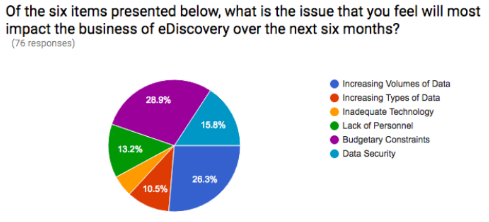
  • Budgetary Constraints and Data Security are Expected to be Most Impact eDiscovery Business: Perhaps the most interesting question is the one where Rob asked which issue that you feel will most impact the business of eDiscovery over the next six months. Budgetary Constraints (22.5%) led the way, closely followed by Data Security (21.3%), Increasing Volumes of Data (20%), Lack of Personnel (16.2%), Increasing Types of Data (13.8%) and finally, Inadequate Technology (6.3%).  I was surprised how even the distribution was across most of the categories.  The graph below illustrates the distribution.

Rob has published the results on his site here, which shows responses to additional questions not referenced here.  Check it out.

One of the great things about LegalTech New York (LTNY) is the ability to, not only to catch up with familiar faces, but also to meet new thought leaders in the industry.  One of those that I met this year for the first time was Chris Dale, director of the UK-based eDisclosure Information Project, whose thought leader interview will be published tomorrow.

Another was Andrew Haslam, who has a terrific UK-based (it was my year to meet Brits!) site called Allvision, where he publishes various posts, including an annual Buyer’s Guide to eDisclosure Systems and a report from LTNY every year.  This year’s report –titled LegalTech 2016 – Cloud, Consolidation and Cybersecurity (which is comprehensive and succinct at the same time) checks in at 18 pages and is well worth the read.  Here is the link to the report.

Andrew clearly gets around during the show, attending sessions and also meeting with lots of companies during the show.  In his report, he obtained quotes from and reported meetings with several of them, including Litsavant, Yerra Solutions, Control Risk, TRU Staffing Partners, Consilio, kCura, Ricoh, Zapproved, Venio Systems, FTI, QuisLex, TCDI, QDiscovery, Xact Data Discovery, Opus 2 International, Catalyst, UnitedLex, Guidance, IPro, and (last, but not least) CloudNine.  It was nice to meet Andrew and nice to see our write-up as well as to see quotes from us about the show.  As for plans for expansion to the UK (which I love and spent part of my honeymoon in 2014), my motto is “never say never!”  Of course, I will be happy to volunteer to set that up.  :o)

So, what do you think?  What’s your state of confidence in the business of eDiscovery?  Please share any comments you might have or if you’d like to know more about a particular topic.

Disclaimer: The views represented herein are exclusively the views of the author, and do not necessarily represent the views held by CloudNine. eDiscovery Daily is made available by CloudNine solely for educational purposes to provide general information about general eDiscovery principles and not to provide specific legal advice applicable to any particular circumstance. eDiscovery Daily should not be used as a substitute for competent legal advice from a lawyer you have retained and who has agreed to represent you.