eDiscoveryDaily

Wednesday’s Relativity Fest Sessions: eDiscovery Trends

As we noted yesterday and Monday, the 2018 Relativity Fest conference is going on this week, CloudNine will once again be here as a Silver Sponsor and I have been covering the show for eDiscovery Daily.  Let’s check out sessions lined up for today, the last day of the conference.

This year, Relativity Fest has been September 30 through October 3 in Chicago at The Hilton Chicago.  As a development partner in the Relativity ecosystem, CloudNine is at the conference and will be there today to provide demonstrations of our Outpost for Relativity capability that automatically ingests and loads data into Relativity based on your specified criteria.  Also, I had a great time speaking at the Social Media session yesterday, moderated by Phil Favro, with Amy Sellars, Craig Carpenter and Ignatius Grande!

Here is one of the eDiscovery-related sessions for today (it’s a short day):

9:00 AM – 10:00 AM:

LIE230322 – e-Discovery Law and Practice: Case Studies in Cooperation

From The Sedona Conference Cooperation Proclamation and the judges across the nation who have endorsed it to the 2015 amendments to the Federal Rules of Civil Procedure, cooperation in e-discovery has become an important consideration in the United States and internationally as well. However, is cooperation in e-discovery even possible in an adversarial system? Even if it is possible, is it practical? How can you cooperate with an adversary? What about transparency in the process? What do other nations think about cooperation in e-discovery and e-disclosure?

Join us for a case study in e-discovery cooperation where e-discovery teams for both plaintiffs and corporate defendants discuss how they used technology and e-discovery workflows to not only conduct e-discovery with cooperation, but do it better, faster, and cheaper. This session has been submitted for CLE accreditation.

This session has been submitted for CLE accreditation.

Speakers Include: David Horrigan – Discovery Counsel and Legal Education Director, Relativity, Chad Roberts – Discovery Counsel, eDiscovery Co-Counsel, PLLC, Kelly Twigger – Principal, ESI Attorneys LLC, Suzanne Clark – Discovery Counsel, eDiscovery Co-Counsel, PLLC, Kathleen Porter Kristiansen – Senior Consultant and Solicitor, Risk Management & Cyber Security, Advanced Discovery.

Hopefully, you enjoyed Relativity Fest this year!  If not, there’s always next year!

So, what do you think?  Did you attend Relativity Fest this year?  Was it worthwhile?  Please share any comments you might have or if you’d like to know more about a particular topic.

Sponsor: This blog is sponsored by CloudNine, which is a data and legal discovery technology company with proven expertise in simplifying and automating the discovery of data for audits, investigations, and litigation. Used by legal and business customers worldwide including more than 50 of the top 250 Am Law firms and many of the world’s leading corporations, CloudNine’s eDiscovery automation software and services help customers gain insight and intelligence on electronic data.

Disclaimer: The views represented herein are exclusively the views of the author, and do not necessarily represent the views held by CloudNine. eDiscovery Daily is made available by CloudNine solely for educational purposes to provide general information about general eDiscovery principles and not to provide specific legal advice applicable to any particular circumstance. eDiscovery Daily should not be used as a substitute for competent legal advice from a lawyer you have retained and who has agreed to represent you.

Tuesday’s Relativity Fest Sessions: eDiscovery Trends

As we noted yesterday the 2018 Relativity Fest conference is going on this week, CloudNine will once again be here as a Silver Sponsor and I will be covering the show for eDiscovery Daily.  Let’s check out some of the sessions lined up for today.

This year, Relativity Fest is September 30 through October 3 in Chicago at The Hilton Chicago.  If you’re in the Chicago area, you can still make it for nearly all of the conference or attend on a one-day pass.  As a development partner in the Relativity ecosystem, CloudNine will once again be the conference and will be there to provide demonstrations of our Outpost for Relativity capability that automatically ingests and loads data into Relativity based on your specified criteria.  Also, I’m delighted to say that I will also once again be speaking at a session at the conference today!

Here are some of the eDiscovery-related sessions for today:

8:30 AM – 9:30 AM:

LIE227578 – International e-Discovery and Data Protection

2018 has been a significant year for international e-discovery, and the annual international session will address important issues that have affected cross-order discovery and data law generally, including the General Data Protection Regulation (GDPR), United States v. Microsoft, and the CLOUD Act, as well as upcoming important topics, such as the EU’s ePrivacy Regulation.  This session has been submitted for CLE accreditation.

Speakers Include: Chris Dale – Founder, eDisclosure Information Project, Heidi Stenberg – Principal | Assurance Services | Fraud Investigation & Dispute Services, EY, Karyn Harty – Partner, McCann FitzGerald, Karl Hennessee – Senior Vice President, Litigation, Investigations & Regulatory Affairs, Airbus, Johnny Lee – Principal & National Practice Leader, Forensic Technology Services, Grant Thornton US LLP.

11:10 AM – 12:10 PM:

PD188410 – Fostering Inclusiveness: Promoting Diversity and Inclusion on Your e-Discovery Team

Fostering environments that provide openness and inclusion has been proven to drive team performance, innovation, and employee retention. Recognizing the benefits of diversity in the workplace is only the first step—how do you build a culture of diversity into your e-discovery business? Relativity Fest is a unique opportunity to have a productive dialogue around how we, as a community, promote diversity both within our own organizations and within the larger e-discovery and legal world.

This 60-minute panel will discuss ways of driving inclusion in your practice and inspire a vision of an inclusive e-discovery community. The panel will cover:

  • Why diversity matters to e-discovery
  • How to foster a culture of inclusion, diversity, and openness, as well as promote diversity of thought
  • Strategies for finding and retaining diverse talent
  • How to make inclusion part of your e-discovery DNA
  • Selling diversity initiatives internally to your organization and gaining alignment on why it’s an important investment
  • Unlocking inclusion with global e-discovery teams

Speakers Include: Drew Stern – Founder & Co-CEO, Esquify, Elizabeth Anastasia – Director of Technology Operations, Perkins Coie LLP, Will Syvongsa – Technical Business Analyst, Relativity, Maria Zanfini – Vice President & Senior Managing Counsel, Investigations, Mastercard, Antonio Avant – Manager, Litigation Technology, Troutman Sanders eMerge, Mary Mack, ACEDS.

LIE230321 – ILTA and Relativity Fest Present Finding the Fun in Writing Fundamentals

Writing skills are mission critical for lawyers and paralegals, and studies show that even those in the technical fields advance faster and are more effective with colleagues if they know how to write well.

The International Legal Technology Association (ILTA) began Finding the Fun in Writing Fundamentals, a legal technology writing skills program, at ILTACON, and now ILTA and Relativity are pleased to bring it to you in an ILTA webinar live from Relativity Fest. Whether you’re trying to write motions, pleadings, effective emails, team bios, technical training manuals, client timekeeping entries, blogs, or social media posts, this program will guide you through the writing process and help you communicate better in the legal technology workplace.  In addition, we’ll examine legal matters where writing errors have influenced the outcome of the case.

Join us for writing best practices from Gary Kinder of Wordrake, a nationally recognized writing coach who has appeared on The New York Times Best Sellers List, and Relativity’s David Horrigan, a longtime legal author and former reporter and assistant editor at The National Law Journal—with retired US Magistrate Judge Andrew Peck of DLA Piper providing guidance and sharing some of the biggest legal writing blunders he’s seen—in this fun and educational program.

This session has been submitted for CLE accreditation.

Speakers Include: David Horrigan – Discovery Counsel and Legal Education Director, Relativity, Honorable Andrew Peck – Retired U.S. Magistrate Judge (S.D.N.Y) and Senior Counsel, DLA Piper, Gary Kinder – Founder, WordRake.

3:40 PM – 4:40 PM:

LIE227576 – Social Media Law and Practice

Join Relativity and the Coalition of Technology Resources for Lawyers in this session covering the latest case law and rules on the discovery of social media data, including the 2017 amendments to Fed. R. Evid. 902, as well as practical considerations for dealing with social media data.  This session has been submitted for CLE accreditation.

Speakers Include: Phil Favro – Consultant, Driven, Inc., Amy Sellers – Associate General Counsel, Walmart, Craig Carpenter – CEO, X1, Doug Austin – VP of Products, CloudNine.

5:00 PM – 6:00 PM:

LIE231935 – e-Discovery in the Cloud: Legal, Ethical and Security Considerations

As e-discovery and the legal profession continue to join the rest of business and society in the move to the cloud, legal teams are encountering new legal, ethical, and security issues. Jurisdictional considerations, information governance—including system security and data privacy—and ethical considerations, including ethical requirements for technological competence, are important issues. Join us for a new version of this popular session with timely new updates, including 2018 case law and regulatory developments.  This session has been submitted for CLE accreditation.

Speakers Include: David Horrigan – Discovery Counsel and Legal Education Director, Relativity, David Kilgore – Corporate Counsel, Rackspace, Karl Hennessee – Senior Vice President, Litigation, Investigations & Regulatory Affairs, Airbus, Dennis Garcia – Assistant General Counsel, Microsoft.

To register to attend Relativity Fest, click here.  It’s not too late!  And, the Cubbies are in the baseball playoffs again (in as a Wild Card – sorry Cubbies!) – though the Astros are going to win it all again this year.  Hey, I was right when I predicted it last year!

So, what do you think?  Are you attending Relativity Fest this year?  Please share any comments you might have or if you’d like to know more about a particular topic.

Sponsor: This blog is sponsored by CloudNine, which is a data and legal discovery technology company with proven expertise in simplifying and automating the discovery of data for audits, investigations, and litigation. Used by legal and business customers worldwide including more than 50 of the top 250 Am Law firms and many of the world’s leading corporations, CloudNine’s eDiscovery automation software and services help customers gain insight and intelligence on electronic data.

Disclaimer: The views represented herein are exclusively the views of the author, and do not necessarily represent the views held by CloudNine. eDiscovery Daily is made available by CloudNine solely for educational purposes to provide general information about general eDiscovery principles and not to provide specific legal advice applicable to any particular circumstance. eDiscovery Daily should not be used as a substitute for competent legal advice from a lawyer you have retained and who has agreed to represent you.
Whee! What a Great Event at the Second Annual WiE Legal Technology Showcase and Conference: eDiscovery Trends

As I noted yesterday, the Women in eDiscovery (WiE), Houston Chapter, in partnership with South Texas College of Law and the Association of Certified E-Discovery Specialists (ACEDS), hosted the second annual “Legal Technology Showcase & Conference” yesterday.  Here are a few pictorial highlights of yesterday’s conference (with a few comments thrown in).

The conference ran from 8:30am to 4:15pm, with a networking happy hour from 4:30pm to 7:00pm.  Both events were at South Texas College of Law in downtown Houston.  Sessions were interspersed with networking time of at least 30 minutes in between, which gave plenty of opportunity to catch up with colleagues and old friends.  The event was a huge success, with a reported total of 239 attendees (considerably more than last year’s inaugural event).  After two years, it may be safe to say that this annual event has already become the most significant eDiscovery conference in the Houston area!

I did not attend the eDiscovery Fundamentals session conducted from 8:30am-9:30am by Scott Lombard who is the Senior Vice President of eDiscovery at JND Legal Administration (I’m sure it was great!).  But I did attend the other sessions.

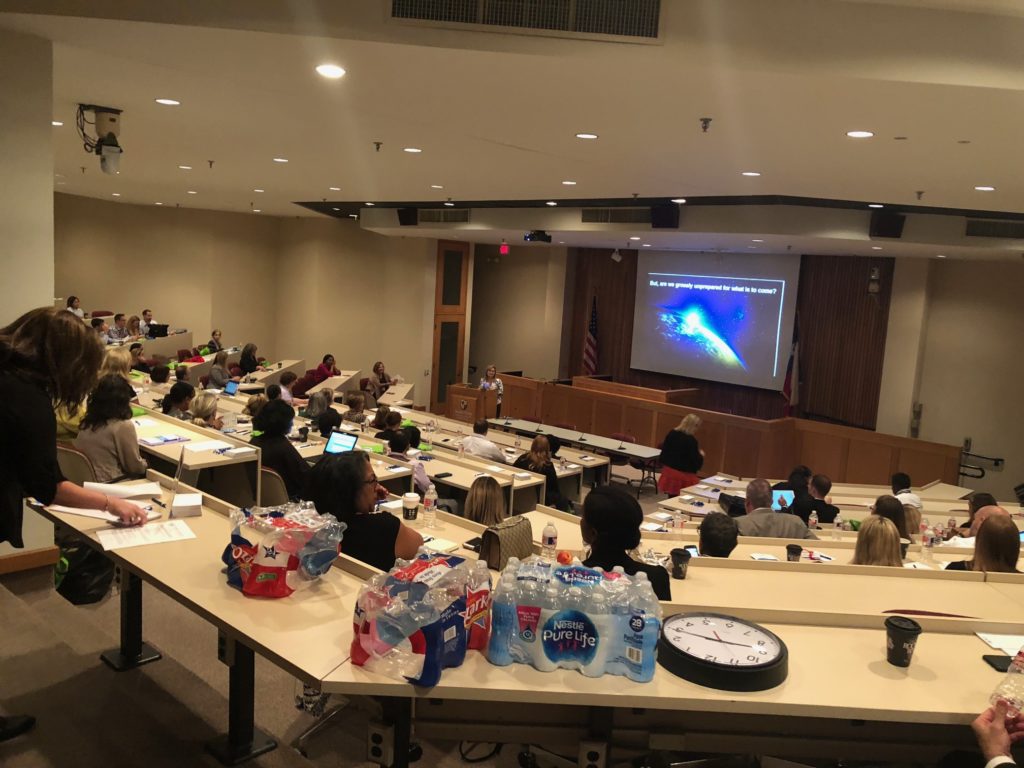
The keynote address (The Future Practice of Law: AI, Blockchain and Quantum Computing) was presented by Shawnna Hoffman, Global Co-Leader of the IBM Cognitive Legal Practice, IBM from 10:00am-11:00am.  Shawnna is a co-founder of WiE, with years of experience in legal technology with providers like LexisNexis and Navigant.  I took a picture of the room during Shawnna’s keynote address here:

Shawnna did a good job of discussing several aspects of AI, blockchain and quantum computing and related them to eDiscovery and legal technology.  One specific example she related regarding Judge Anthony Capizzi in Montgomery County, Ohio where IBM Watson interfaces with the county’s case management system, providing up-to-the-minute summaries of relevant information, patterns for things such as drug use, which help the judge and team understand the ups and downs in the child’s life.

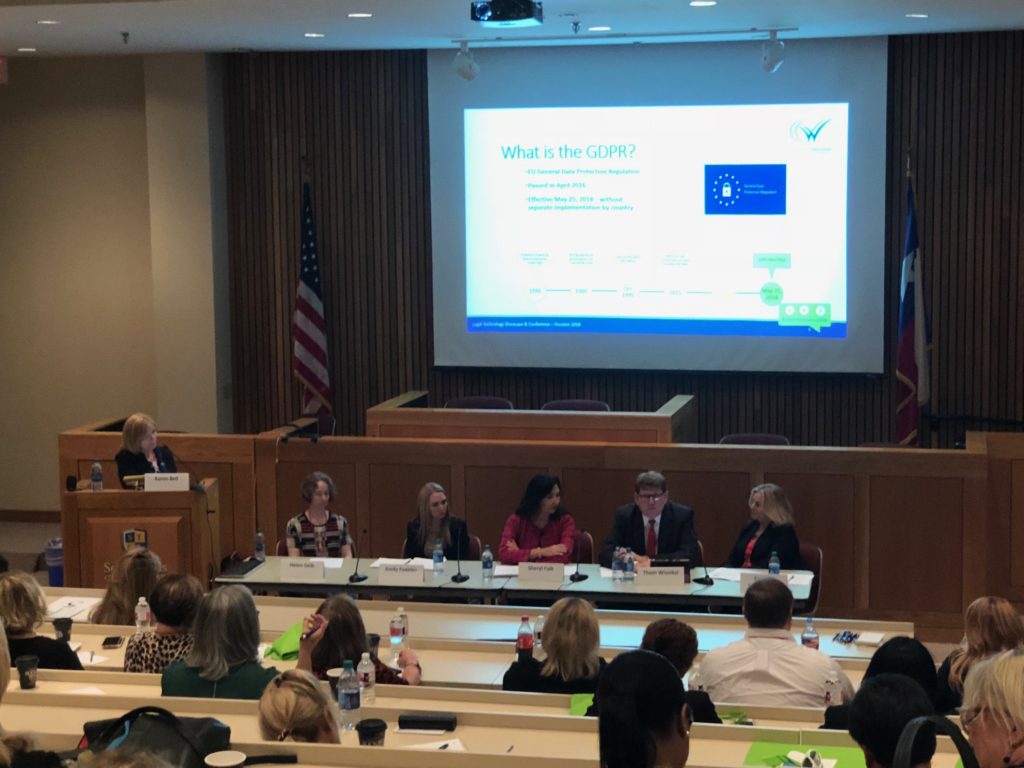
The next session was Data Privacy & GDPR | The Age of the GDPR – A Perspective Four Months In from 11:30am-12:30pm, with Moderator: Karen Bell, Consul General, British Consulate General Houston and panelists Sheryl Falk, Partner, Winston & Strawn; Emily Fedeles, Associate, BakerHostetler; Helen Geib, General Counsel, QDiscovery; Carolyn Southerland, Managing Director, Morae Global; Thom Wisinski, Chief Knowledge Officer, Haynes & Boone.

That panel (pictured below) had a lot of useful information about how things are going four months into GDPR.  One of the things they mentioned was the Ticketmaster data breach earlier this year which affected EU users and for which Monzo, a mobile-only bank based in the UK, stated that it had spotted signs of the breach and warned Ticketmaster 2 1/2 months earlier than it was reported by Ticketmaster after around 50 of the bank’s customers reported fraudulent transactions on their accounts.  Whoops.

No GDPR violations/fines have been reported – yet.

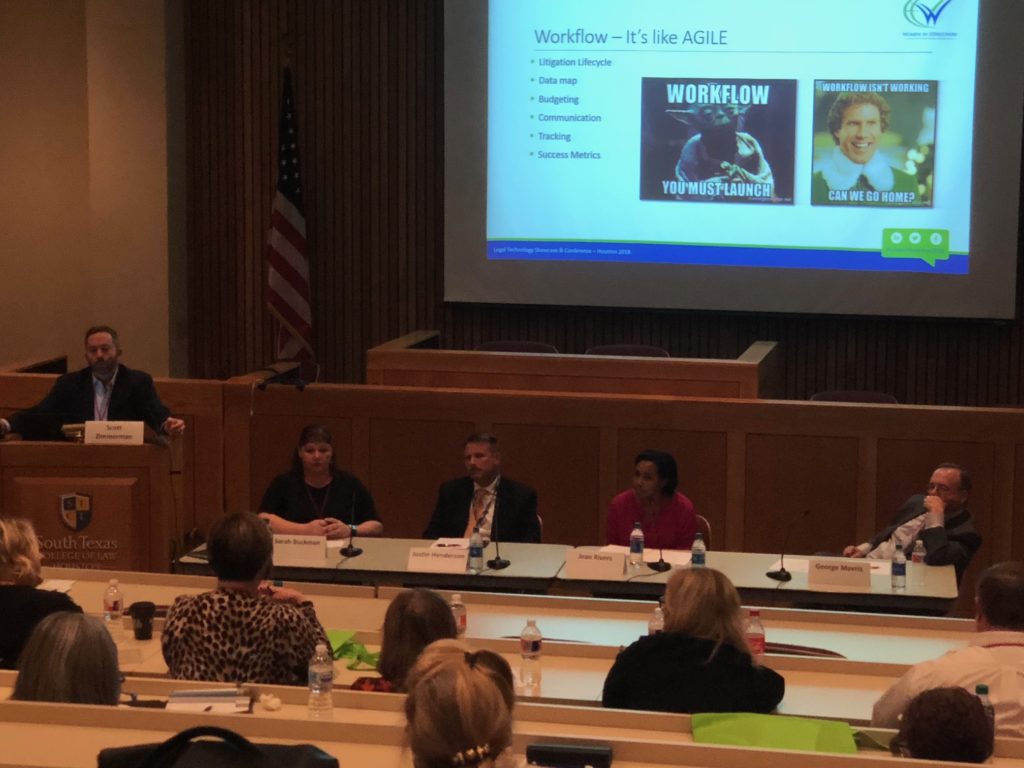
After a box lunch, the Discovery Project Management: Navigating the Workflow (and budgets) session was conducted from 1:30pm-2:30pm, with Moderator: Scott Zimmerman, Manager of Automated Legal Services, Haynes & Boone and panelists Sarah Buckman, Discovery Consultant, Litigation Solutions, Inc.; Justin Henderson, Senior Project Manager, Consilio; George Mavris, Manager IT Appl – HR / Document Production / ECM, Citgo Petroleum; Jean Rivers, Director of Litigation Support, Berg & Androphy.  This terrific panel did a great job of not only keeping the topic light and funny, but also involving the audience and getting them to share some of their experiences with regard to project management experiences.  Here’s a picture of that panel:

That leaves the panel I was on – AI and TAR for Legal: Use Cases for Discovery and Beyond – from 3:00pm-4:00pm.  The panel was moderated by: Jackie Rosborough, Discovery & Trial Consultant (and Executive Director of Wie), with panelists May Tal Gongolevsky, Counsel, BakerHostetler; Ben Sexton, Director of eDiscovery, JND Legal Administration; Maren Strandevold, Solicitor, Haynes and Boone CDG, LLP and me.  We discussed the ins and outs of AI and TAR, particularly related to the terminology (not everyone sees TAR the same way), the challenges to successful TAR projects (including types of cases, file types and other issues that are more or less conducive to TAR) and what attorneys should expect from TAR.  Obviously, I couldn’t take a picture of our own panel, so you will have to take my word for it.  :o)

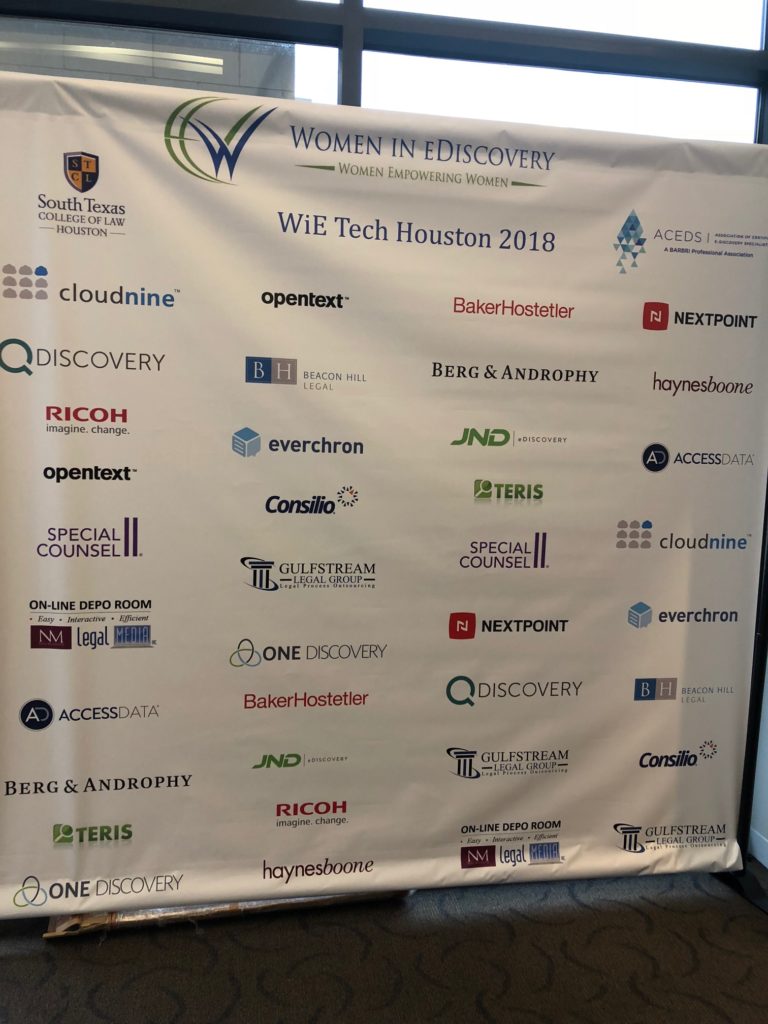
The event was possible due to a number of sponsors (pictured below) including CloudNine, who was a Premier Platinum Sponsor and we were happy to participate!  We look forward to next year’s event!

So, what do you think?  Are you based in Houston?  If so, you absolutely have to attend next year’s event!  Please share any comments you might have or if you’d like to know more about a particular topic.

Sponsor: This blog is sponsored by CloudNine, which is a data and legal discovery technology company with proven expertise in simplifying and automating the discovery of data for audits, investigations, and litigation. Used by legal and business customers worldwide including more than 50 of the top 250 Am Law firms and many of the world’s leading corporations, CloudNine’s eDiscovery automation software and services help customers gain insight and intelligence on electronic data.

Disclaimer: The views represented herein are exclusively the views of the author, and do not necessarily represent the views held by CloudNine. eDiscovery Daily is made available by CloudNine solely for educational purposes to provide general information about general eDiscovery principles and not to provide specific legal advice applicable to any particular circumstance. eDiscovery Daily should not be used as a substitute for competent legal advice from a lawyer you have retained and who has agreed to represent you.
Today is the Day for the Second Annual WiE Legal Technology Showcase and Conference: eDiscovery Best Practices

Today, the Women in eDiscovery (WiE), Houston Chapter, in partnership with South Texas College of Law and the Association of Certified E-Discovery Specialists (ACEDS), will be hosting the second annual “Legal Technology Showcase & Conference”.  The one-day technology showcase will bring together legal thought leadership, innovative technology providers, practitioners, legal support staff and law school students in one venue to network and collaborate on current legal industry trends and innovative technology products.

Thanks to South Texas College of Law, ACEDS, conference sponsors and technology exhibitors, the event is free to attend and open to all professionals within the legal industry including attorneys, litigation support and legal operations professionals, paralegals, legal IT staff, court reporters, consultants, recruiters and vendors.

Today’s event will feature several educational sessions led by industry experts and thought leaders along with a full day of technology exhibits from leading legal technology providers. The event agenda includes a continental breakfast, welcome keynote, three educational sessions, lunch, all day exhibitions, and a post-event happy hour.  Attendees will also have the opportunity to enter in a drawing to win a CEDS scholarship courtesy of ACEDS.

Here is a link to the agenda and also a link to the list of speakers for the conference.

I’m excited to be one of the speakers again this year on the panel discussion AI and TAR for Legal: Use Cases for Discovery and Beyond at 3:00pm and CloudNine is also a Premier Platinum Sponsor for the event (as well as an Exhibitor, so you can come learn about us too).

The conference runs from 8:30am to 4:15pm, with a networking happy hour from 4:30pm to 7:00pm.  Both events are at South Texas College of Law in downtown Houston.

Here’s the bad news.  Unfortunately, I checked last night and they say registrations are closed for the event.  So, unless you’re already registered or know somebody – slip me a $20 and I’ll see what I can do ;o) – you’re out of luck for this year’s event.  Why would I tell you about an event that you can no longer register for?  So, you’ll register earlier next year, that’s why!  :o)

So, what do you think?  Are you going to today’s event?  If so, I’ll see you there!  Please share any comments you might have or if you’d like to know more about a particular topic.

Also, I want to thank BakerHostetler for hosting an event on “Executive Presence” yesterday, which was followed by a happy hour.  I learned a lot about how successful executives demonstrate presence (not just at work but in all situations) from a terrific panel and some of my colleagues in a breakout session.

Sponsor: This blog is sponsored by CloudNine, which is a data and legal discovery technology company with proven expertise in simplifying and automating the discovery of data for audits, investigations, and litigation. Used by legal and business customers worldwide including more than 50 of the top 250 Am Law firms and many of the world’s leading corporations, CloudNine’s eDiscovery automation software and services help customers gain insight and intelligence on electronic data.

Disclaimer: The views represented herein are exclusively the views of the author, and do not necessarily represent the views held by CloudNine. eDiscovery Daily is made available by CloudNine solely for educational purposes to provide general information about general eDiscovery principles and not to provide specific legal advice applicable to any particular circumstance. eDiscovery Daily should not be used as a substitute for competent legal advice from a lawyer you have retained and who has agreed to represent you.
Today is the Day to Learn How to Prepare for Litigation Before it Happens: eDiscovery Webcasts

Information Governance (IG) has always been part of the eDiscovery landscape and it has always been important for reducing the population of potentially responsive electronically stored information (ESI) that might be subject to litigation by helping organizations adopt best practices for keeping their information “house in order”. But how can you leverage IG best practices to prepare for litigation before it happens?  Find out in our webcast today!

Today at noon CST (1:00pm EST, 10:00am PST), CloudNine will conduct the webcast Preparing for Litigation Before it Happens. In this one-hour webcast that’s CLE-approved in selected states, we will explore the implementation of Information Governance best practices to help organizations better prepare for litigation before it happens. Topics include:

  • Minority Report: Pre-Case for Litigation Avoidance
  • What Information Governance is and What it Isn’t
  • General Principles for Information Governance
  • Who Uses Information Governance?
  • IG Considerations and Issues
  • Basic Information Governance Solutions
  • Information Governance vs. Analytics
  • How Privacy/Security Has Impacted the Importance of an IG Program
  • Recommendations for Implementing an IG Program

As always, I’ll be presenting the webcast, along with Tom O’Connor – who wrote a seven(!) part blog post series on the topic.  To register for it, click here.  Even if you can’t make it, go ahead and register to get a link to the slides and to the recording of the webcast (if you want to check it out later).  If you want to know how to leverage IG best practices to prepare for litigation before it happens, this is the webcast for you!

So, what do you think?  Is your organization as prepared as it could be for impending litigation?  If not, please join us!  And, as always, please share any comments you might have or if you’d like to know more about a particular topic.

Also, if you’re going to be in Houston tomorrow, September 27, just a reminder that I will be speaking at the second annual Legal Technology Showcase & Conference, hosted by the Women in eDiscovery (WiE), Houston Chapter, South Texas College of Law and the Association of Certified E-Discovery Specialists (ACEDS).  I’ll be part of the panel discussion AI and TAR for Legal: Use Cases for Discovery and Beyond at 3:00pm and CloudNine is also a Premier Platinum Sponsor for the event (as well as an Exhibitor, so you can come learn about us too).  Click here to register!

Sponsor: This blog is sponsored by CloudNine, which is a data and legal discovery technology company with proven expertise in simplifying and automating the discovery of data for audits, investigations, and litigation. Used by legal and business customers worldwide including more than 50 of the top 250 Am Law firms and many of the world’s leading corporations, CloudNine’s eDiscovery automation software and services help customers gain insight and intelligence on electronic data.

Disclaimer: The views represented herein are exclusively the views of the author, and do not necessarily represent the views held by CloudNine. eDiscovery Daily is made available by CloudNine solely for educational purposes to provide general information about general eDiscovery principles and not to provide specific legal advice applicable to any particular circumstance. eDiscovery Daily should not be used as a substitute for competent legal advice from a lawyer you have retained and who has agreed to represent you.

Eight is Great! eDiscovery Daily is Eight Years Old!

As a loving husband, it’s a bad thing to forget an anniversary.  Thankfully, I forgot the other one.

Holy $#*%@!  I can’t believe I missed the anniversary for the blog!  It snuck up on me.  Anyway, believe it or not, it has been eight years ago last Thursday since we launched the eDiscovery Daily blog!

We launched eight years ago on September 20, 2010.  Back then, we told you to not get “wild” with wildcards and published our first case law post about a case where the spoliator of data was actually threatened with jail time –  our first of 640 posts about case law to date, covering more than 500 distinct cases!  We’ve published over 2,101 lifetime posts, and every post is still available on the site for your reference.  We’re eight, but we’re not behind the eight ball!

As always, we have you to thank for all of that success!  Thanks for making the eDiscovery Daily blog a regular resource for your eDiscovery news and analysis!  We really appreciate the support!

As many of you know by now, we like to take a look back every six months at some of the important stories and topics during that time.  So, here are some posts over the last few months you may have missed.  Enjoy!

OK, let me get this straight: Twitter doesn’t have custody and control over its own direct messages?

Are private Facebook photos discoverable in a personal injury case?  Depends on which court you ask.

Talk about fingering a suspect!  Cops are now opening iPhones with dead people’s fingerprints.

Do you watch movies and TV shows on Netflix or Amazon Prime?  Or, listen to music on Pandora or Spotify?  Then, you may be a user of predictive coding technology and not realize it.

What happens in the Internet each minute in 2018? More than ever.

More than two thirds of data breaches take months to discover.

If you use “sock puppet” accounts to try to defame the author whose copyrighted book you infringed and try to hide it, you might get sanctioned.

What percentage of Freedom of Information Act (FOIA) requests actually result in receiving all of the information requested? 75 percent? 50 percent? You might be surprised.

Can you still be sanctioned after a jury verdict?  Better believe it.

Artificial intelligence (AI) is transforming the practice of law, but could it (finally) spell the end of the billable hour?

Are you “primed” to learn best practices for handling social media?  The Sedona Conference® can help!

2018 is certainly on its way to becoming the year of data privacy rights for the individual – especially in California.

Public or private cloud isn’t the only question you should be asking about a cloud solution, you could have as many as three providers associated with your solution.  Do you know how to evaluate them?

Does accessing historical records containing the physical locations of cellphones without a search warrant violate the Fourth Amendment?  Let’s ask SCOTUS!

Over the past few years, private equity firms have invested in over a dozen eDiscovery companies (including this one).

Leave it to Craig Ball to come up with a sensible forensic examination protocol that you can use and learn from.

This is just a sampling of topics that we’ve covered.  Hope you enjoyed them!

Thanks for the interest you’ve shown in the topics!  We will do our best to continue to provide interesting and useful eDiscovery news and analysis.  And, as always, please share any comments you might have or if you’d like to know more about a particular topic!  On to 9 years!  (Cloud)Nine will be divine!  :o)

Sponsor: This blog is sponsored by CloudNine, which is a data and legal discovery technology company with proven expertise in simplifying and automating the discovery of data for audits, investigations, and litigation. Used by legal and business customers worldwide including more than 50 of the top 250 Am Law firms and many of the world’s leading corporations, CloudNine’s eDiscovery automation software and services help customers gain insight and intelligence on electronic data.

Disclaimer: The views represented herein are exclusively the views of the author, and do not necessarily represent the views held by CloudNine. eDiscovery Daily is made available by CloudNine solely for educational purposes to provide general information about general eDiscovery principles and not to provide specific legal advice applicable to any particular circumstance. eDiscovery Daily should not be used as a substitute for competent legal advice from a lawyer you have retained and who has agreed to represent you.

In No Small Ruling, Court Takes Defendant to Task for Discovery Violations: eDiscovery Case Law

In Small v. Univ. Med. Ctr., No. 2:13-cv-0298-APG-PAL (D. Nev. Aug. 9, 2018), Nevada Magistrate Judge Peggy A. Leen, in a lengthy ruling so large it included a table of contents, accepted and adopted in part and overruled in part the Special Master’s Report and Recommendation and Final Findings of Fact and Conclusions of Law.  Judge Leen sanctioned the defendant with an adverse inference instruction to the jury instead of the default judgment sanction recommended by the special master.

Case Background

In this case involving claims against the defendant for unpaid wages and overtime which followed a Department of Labor (“DOL”) investigation that addressed issues about uncompensated time for hourly employees related to uncompensated meal breaks, the court “reluctantly” appointed a special master after “a series of hearings over many months made it painfully apparent” that the defendant, its counsel, and consultants were failing in their efforts to produce ESI responsive to plaintiffs’ discovery requests, including issuing a production to the plaintiffs that was mostly “unintelligible” with extracted text in pages of undecipherable codes complete with Japanese and Korean characters.

In special master Daniel Garrie’s report (covered by us nearly four years ago here), he found that “Not a single UMC executive took any of the steps necessary to ensure the preservation of evidence. No UMC executive took responsibility for instituting or enforcing a ‘litigation hold,’ or otherwise acting to ensure the preservation of documents in this case.”  Calling the defendant’s widespread failure to preserve data a “mockery of the orderly administration of justice”, he recommended sanctions, stating, “Defendant UMC’s extraordinary misconduct and substantial and willful spoliation of relevant ESI in this case resulted in substantial prejudice to Plaintiffs and the classes, and misled Plaintiffs, the Court, and the Special Master on numerous discovery issues…The level of intentional destruction of evidence by UMC shocks the conscious. As such, as to the 613 Opt-In Plaintiffs, default judgment should be entered against UMC pursuant to Rule 37(b)(2)(A)(iii) & (vi) and the Court’s inherent powers.”

Judge’s Ruling

In a lengthy ruling that re-capped in detail the complaint, the various hearings regarding eDiscovery issues and various declarations during the special master proceedings, Judge Leen stated the following findings and conclusions:

  • “Special Master Garrie was Professional, Neutral, Possessed Specialized Knowledge and Expertise, and Remedied Much of UMC’s ESI Deficiencies” (despite the defendant’s contentions to the contrary);
  • “UMC Failed to Comply with the Court’s Orders to Preserve and Produce ESI”;
  • “UMC Had No Preservation Policy or Litigation Hold Policy and Failed to Timely Implement One”;
  • “UMC Executives Failed to Accept Responsibility for Ensuring that ESI was Preserved and Failed to Notify Key Custodians and IT Staff to Preserve, and Prevent Loss, or Destruction of Relevant, Responsive ESI”;
  • “UMC Failed to Disclose the Existence of Relevant ESI Repositories, Including Multiple Timekeeping Systems and the Q-Drive (drive with files containing human resources, corporate compliance, employee grievance, payroll, and DOL investigation data) Until Late in the Special Master Proceedings”;
  • “UMC Modified, Lost, Deleted and/or Destroyed ESI Responsive to Plaintiffs’ Discovery Requests”;
  • “UMC’s Failure to Comply with its Legal Duty to Preserve, Failure to Put in Place a Timely Litigation Hold, Failure to Comply with Multiple Court Orders to Preserve and Produce Responsive ESI, and Loss and Destruction of Responsive ESI (1) Necessitated the Appointment of a Special Master, (2) Caused Substantial Delay of these Proceedings, and (3) Caused Plaintiffs to Incur Needless Monetary Expenses”; and
  • “The Special Master Correctly Concluded UMC Repeatedly Misrepresented the Completeness of its Production of Documents Produced to DOL; However, UMC Was Not Ordered to Produce Kronos Payroll Data in Spreadsheet Format”.

With regard to sanctions for the defendant, Judge Leen stated “There is no question UMC failed to implement a timely litigation hold and failed to communicate its legal preservation duties to key custodians of discoverable evidence. There is no question that UMC failed to preserve discoverable ESI. There is no question data was lost or destroyed as a result. There is no question sanctions are warranted. UMC concedes they are. The only question is what sanctions are appropriate and proportional for the violations.”

Ruling “it is ‘just and practicable’ to apply the amended version of Rule 37(e)”, Judge Leen ultimately determined “Although the court finds plaintiffs have been prejudiced by the loss of data from key repositories and custodians, the loss has not threatened to interfere with the rightful decision of the case on its merits given the large volume of ESI the special master was able to ensure that UMC produced. For these reasons, the court finds that lesser sanctions are appropriate, proportional, and no greater than necessary to cure the prejudice caused by the loss of ESI uncovered by the special master.”

As a result, Judge Leen, while accepting and adopting the special master’s report, overruled the Special Master’s recommendation of case dispositive sanctions and instead stated: “UMC is sanctioned in the form of an instruction to the jury that the court has found UMC failed to comply with its legal duty to preserve discoverable information, failed to comply with its discovery obligations, and failed to comply with a number of the court’s orders. The instruction will provide that these failures resulted in the loss or destruction of some ESI relevant to the parties’ claims and defenses and responsive to plaintiffs’ discovery requests, and that the jury may consider these findings with all other evidence in the case for whatever value it deems appropriate.”  She also imposed monetary sanctions against the defendant in the form of “reasonable costs and attorneys’ fees unnecessarily incurred by plaintiffs”.

So, what do you think?  Did the court go far enough with sanctions against the defendant?  Please let us know if any comments you might have or if you’d like to know more about a particular topic.

For more about this case, check out this Above the Law article written by Mike Quartararo.

Case opinion link courtesy of eDiscovery Assistant.

Also, if you’re going to be in Houston this Thursday, September 27, just a reminder that I will be speaking at the second annual Legal Technology Showcase & Conference, hosted by the Women in eDiscovery (WiE), Houston Chapter, South Texas College of Law and the Association of Certified E-Discovery Specialists (ACEDS).  I’ll be part of the panel discussion AI and TAR for Legal: Use Cases for Discovery and Beyond at 3:00pm and CloudNine is also a Premier Platinum Sponsor for the event (as well as an Exhibitor, so you can come learn about us too).  Click here to register!

Sponsor: This blog is sponsored by CloudNine, which is a data and legal discovery technology company with proven expertise in simplifying and automating the discovery of data for audits, investigations, and litigation. Used by legal and business customers worldwide including more than 50 of the top 250 Am Law firms and many of the world’s leading corporations, CloudNine’s eDiscovery automation software and services help customers gain insight and intelligence on electronic data.

Disclaimer: The views represented herein are exclusively the views of the author, and do not necessarily represent the views held by CloudNine. eDiscovery Daily is made available by CloudNine solely for educational purposes to provide general information about general eDiscovery principles and not to provide specific legal advice applicable to any particular circumstance. eDiscovery Daily should not be used as a substitute for competent legal advice from a lawyer you have retained and who has agreed to represent you.

Plaintiffs Granted Discovery Extension Due to Defendant’s TAR Review Glitch: eDiscovery Case Law

In the case In Re Domestic Airline Travel Antitrust Litigation, MDL Docket No. 2656, Misc. No. 15-1404 (CKK), (D.D.C. Sept. 13, 2018), District of Columbia District Judge Colleen Kollar-Kotelly granted the Plaintiffs’ Motion for an Extension of Fact Discovery Deadlines (over the defendants’ objections) for six months, finding that defendant “United’s production of core documents that varied greatly from the control set in terms of the applicable standards for recall and precision and included a much larger number of non-responsive documents that was anticipated” (United’s core production of 3.5 million documents contained only 600,000 documents that were responsive).

Case Background

In the case involves a multidistrict class action litigation brought by the plaintiffs (purchasers of air passenger transportation for domestic travel) alleging that the defendant airlines willingly conspired to engage in unlawful restraint of trade, the plaintiffs filed an instant Motion for Extension of Time to Complete Discovery, requesting an extension of six months, predicated on an “issue with United’s ‘core’ document production,” asserting that defendant United produced more than 3.5 million [core] documents to the Plaintiffs, but “due to United’s technology assisted review process (‘TAR’), only approximately 17%, or 600,000, of the documents produced are responsive to Plaintiffs’ requests,” and the plaintiffs (despite having staffed their discovery review with 70 attorneys) required additional time to sort through them.

Both defendants (Delta and United) opposed the plaintiffs’ request for an extension, questioning whether the plaintiffs had staffed the document review with 70 attorneys and suggesting the Court review the plaintiffs’ counsel’s monthly time sheets to verify that statement.  Delta also questioned by it would take the plaintiffs so long to review the documents and tried to extrapolate how long it would take to review the entire set of documents based on a review of 3 documents per minute (an analysis that the plaintiffs called “preposterous”).  United indicated that it engaged “over 180 temporary contract attorneys to accomplish its document production and privilege log process within the deadlines” set by the Court, so the plaintiffs should be expected to engage in the same expenditure of resources.  But, the plaintiffs contended that they “could not have foreseen United’s voluminous document production made up [of] predominantly non-responsive documents resulting from its deficient TAR process when they jointly proposed an extension of the fact discovery deadline in February 2018.”

Judge’s Ruling

Judge Kollar-Kotelly noted that “Plaintiffs contend that a showing of diligence involves three factors — (1) whether the moving party diligently assisted the Court in developing a workable scheduling order; (2) that despite the diligence, the moving party cannot comply with the order due to unforeseen or unanticipated matters; and (3) that the party diligently sought an amendment of the schedule once it became apparent that it could not comply without some modification of the schedule.”  She noted that “there is no dispute that the parties diligently assisted the Court in developing workable scheduling orders through their preparation of Joint Status Reports prior to the status conferences in which discovery issues and scheduling were discussed, and in their meetings with the Special Master, who is handling discovery matters in this case.”

Judge Kollar-Kotelly also observed that “United’s core production of 3.5 million documents — containing numerous nonresponsive documents — was unanticipated by Plaintiffs, considering the circumstances leading up to that production” and that “Plaintiffs devoted considerable resources to the review of the United documents prior to filing this motion seeking an extension”.  Finding also that “Plaintiffs’ claim of prejudice in not having the deadlines extended far outweighs any inconvenience that Defendants will experience if the deadlines are extended”, Judge Kollar-Kotelly found “that Plaintiffs have demonstrated good cause to warrant an extension of deadlines in this case based upon Plaintiffs’ demonstration of diligence and a showing of nominal prejudice to the Defendants, if an extension is granted, while Plaintiffs will be greatly prejudiced if the extension is not granted.”  As a result, she granted the motion to request the extension.

So, what do you think?  Was the court right to have granted the extension?  Please let us know if any comments you might have or if you’d like to know more about a particular topic.

Case opinion link courtesy of eDiscovery Assistant.

Also, if you’re going to be in Houston on Thursday, September 27, just a reminder that I will be speaking at the second annual Legal Technology Showcase & Conference, hosted by the Women in eDiscovery (WiE), Houston Chapter, South Texas College of Law and the Association of Certified E-Discovery Specialists (ACEDS).  I’ll be part of the panel discussion AI and TAR for Legal: Use Cases for Discovery and Beyond at 3:00pm and CloudNine is also a Premier Platinum Sponsor for the event (as well as an Exhibitor, so you can come learn about us too).  Click here to register!

Sponsor: This blog is sponsored by CloudNine, which is a data and legal discovery technology company with proven expertise in simplifying and automating the discovery of data for audits, investigations, and litigation. Used by legal and business customers worldwide including more than 50 of the top 250 Am Law firms and many of the world’s leading corporations, CloudNine’s eDiscovery automation software and services help customers gain insight and intelligence on electronic data.

Disclaimer: The views represented herein are exclusively the views of the author, and do not necessarily represent the views held by CloudNine. eDiscovery Daily is made available by CloudNine solely for educational purposes to provide general information about general eDiscovery principles and not to provide specific legal advice applicable to any particular circumstance. eDiscovery Daily should not be used as a substitute for competent legal advice from a lawyer you have retained and who has agreed to represent you.

Survey Says! Predictive Coding Technologies and Protocols Survey Results: eDiscovery Trends

Last week, I discussed the predictive coding survey that Rob Robinson was conducting on his Complex Discovery site (along with the overview of key predictive coding related terms.  The results are in and here are some of the findings.

As Rob notes in the results post here, the Predictive Coding Technologies and Protocols Survey was initiated on August 31 and concluded on September 15.  It’s a non-scientific survey designed to help provide a general understanding of the use of predictive coding technologies and protocols from data discovery and legal discovery professionals within the eDiscovery ecosystem.  The survey was designed to provide a general understanding of predictive coding technologies and protocols and had two primary educational objectives:

  • To provide a consolidated listing of potential predictive coding technology and protocol definitions. While not all-inclusive or comprehensive, the listing was vetted with selected industry predictive coding experts for completeness and accuracy, thus it appears to be profitable for use in educational efforts.
  • To ask eDiscovery ecosystem professionals about their usage and preferences of predictive coding platforms, technologies, and protocols.

There were 31 total respondents in the survey.  Here are some of the more notable results:

  • More than 80% of responders (80.64%) shared that they did have a specific primary platform for predictive coding versus just under 20% (19.35%), who indicated they did not.
  • There were 12 different platforms noted as primary predictive platforms by responders, but only three platforms received more than one vote and they accounted for more than 50% of responses (61%).
  • Active Learning was the most used predictive coding technology, with more than 70% of responders (70.96%) reporting that they use it in their predictive coding efforts.
  • Just over two-thirds of responders (67.74%) use more than one predictive coding technology in their predictive coding efforts, while just under one-third (32.25%) use only one.
  • Continuous Active Learning (CAL) was (by far) the most used predictive coding protocol, with more than 87% of responders (87.09%) reporting that they use it in their predictive coding efforts.

Rob has reported several other results and provided graphs for additional details.  To check out all of the results, click here.

So, what do you think?  Do any of the results surprise you?  Please share any comments you might have or if you’d like to know more about a particular topic.

Also, if you’re going to be in Houston on Thursday, September 27, just a reminder that I will be speaking at the second annual Legal Technology Showcase & Conference, hosted by the Women in eDiscovery (WiE), Houston Chapter, South Texas College of Law and the Association of Certified E-Discovery Specialists (ACEDS).  I’ll be part of the panel discussion AI and TAR for Legal: Use Cases for Discovery and Beyond at 3:00pm and CloudNine is also a Premier Platinum Sponsor for the event (as well as an Exhibitor, so you can come learn about us too).  Click here to register!

Image Copyright (C) FremantleMedia North America, Inc.

Sponsor: This blog is sponsored by CloudNine, which is a data and legal discovery technology company with proven expertise in simplifying and automating the discovery of data for audits, investigations, and litigation. Used by legal and business customers worldwide including more than 50 of the top 250 Am Law firms and many of the world’s leading corporations, CloudNine’s eDiscovery automation software and services help customers gain insight and intelligence on electronic data.

Disclaimer: The views represented herein are exclusively the views of the author, and do not necessarily represent the views held by CloudNine. eDiscovery Daily is made available by CloudNine solely for educational purposes to provide general information about general eDiscovery principles and not to provide specific legal advice applicable to any particular circumstance. eDiscovery Daily should not be used as a substitute for competent legal advice from a lawyer you have retained and who has agreed to represent you.